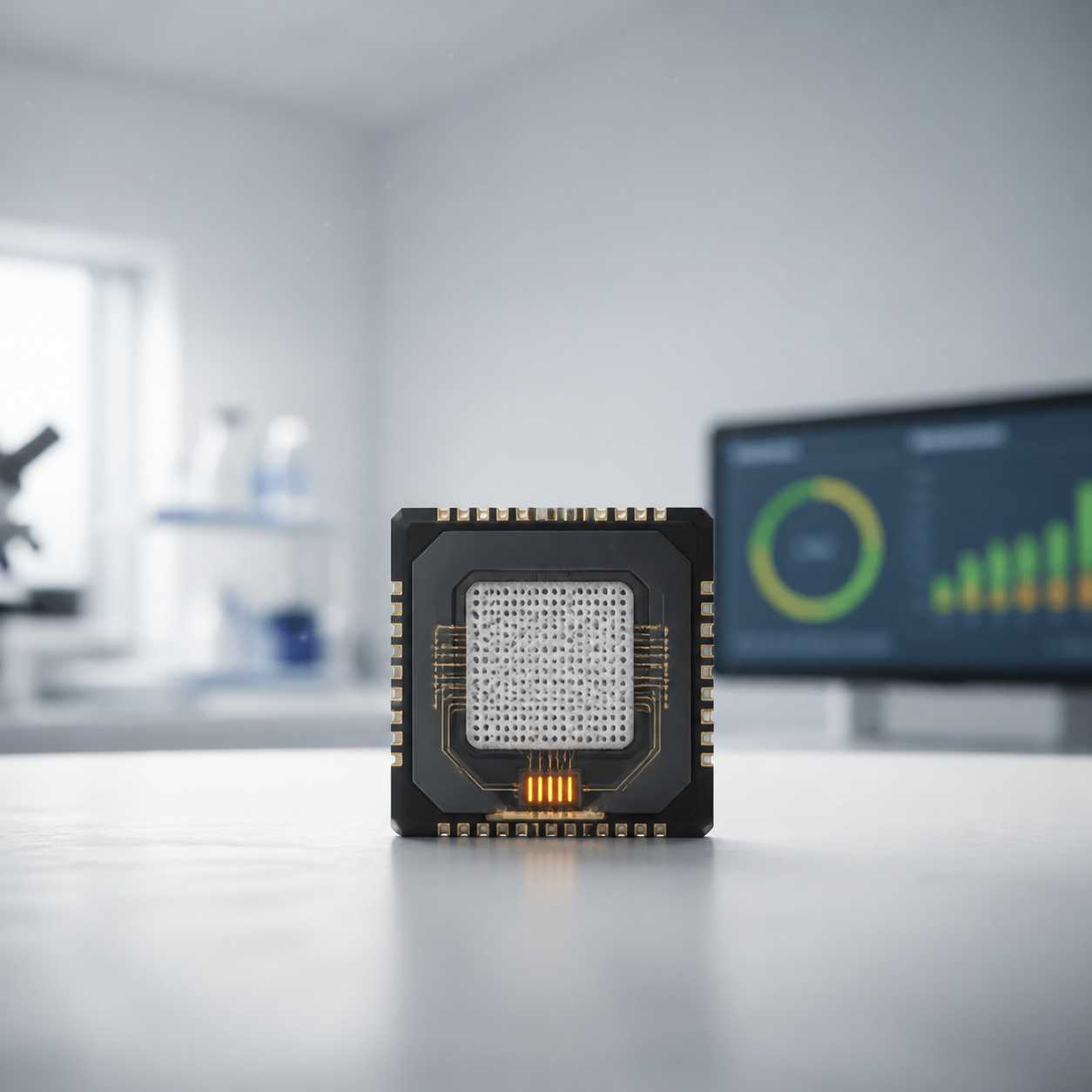
In March 2026, researchers reported a reusable chip for particulate matter sensing that targets two of the most common air-quality measurements: PM10 and PM2.5. The work was published in Microsystems & Nanoengineering and later highlighted by EurekAlert! on April 17, 2026. For environmental monitoring teams, device engineers, and platform builders, the important detail is not only that the sensor measures fine dust, but that it is designed to be reused instead of treated as a one-time element.
The study presents a surface acoustic wave, or SAW, sensor system that combines a porous microstructured membrane with an integrated microheater. The membrane separates particles by size, while the heater helps detach captured particles so the sensor can return to baseline and be used again. That is a meaningful engineering shift because many particulate matter sensors become less practical when particle attachment is irreversible or when recovery requires manual intervention.
The researchers report that the membrane uses pore sizes tuned for selective detection of PM10 and PM2.5, and that the system was tested with real fine dust under controlled conditions. The architecture is built around a two-port SAW resonator on a 128° YX lithium niobate substrate, with the heater co-fabricated to reduce processing time and cost. In other words, this is not just a lab demo of sensitivity; it is an attempt to make sensing hardware more compatible with field use.
That matters because air-quality monitoring is only useful when the device can produce reliable data over time with minimal service overhead. For industrial sites, buildings, logistics hubs, and smart-city deployments, the hidden cost is often not the sensor itself but calibration drift, replacement cycles, and the manual work needed to keep data trustworthy. A reusable chip changes the operational model by making cleanup and recovery part of the device design rather than an afterthought.
Why Reusability Changes the Business Case
Many particulate matter sensors are designed around direct particle capture, which can improve sensitivity but creates a lifecycle problem. Once particles are attached, performance can degrade, the device may need replacement, or an operator may have to run a manual recovery step. The paper’s key contribution is that it addresses sensing and recovery together.
For product teams, that combination affects cost of ownership, maintenance intervals, and deployment scale. A reusable chip can support more continuous monitoring workflows, especially when the sensor feeds a dashboard, API, or automation layer that depends on stable long-term readings rather than short bursts of test data.
It also changes how systems are validated. A one-time sensor can be acceptable for a prototype, but reusable hardware forces teams to test recovery behavior, repeatability, thermal impact, and baseline restoration across many cycles. That is the kind of engineering detail that determines whether a concept can become a dependable connected device.
How the Sensor Works
According to the report, the device uses a porous microstructure membrane as a mechanical filter to separate particles by size. The membrane is designed with openings that support selective detection of PM2.5 and PM10, so the system can distinguish between the two categories rather than treating all airborne dust as a single signal.
The sensor also integrates a microheater on the same platform. After exposure to particulate matter, the heater is activated to raise the temperature and detach particles from the sensing surface. The researchers report that the sensor was able to return to baseline under vacuum conditions, which is the core requirement for reusability.
The work used COMSOL simulations to study thermal behavior, particle trajectories, and detachment behavior, and the experiments relied on multi-channel interface electronics to monitor frequency shifts in real time. That detail is relevant for platform teams because it shows the sensor is not isolated hardware; it depends on signal conditioning, timing, and instrumentation to produce usable data.
What It Means for Connected Monitoring Systems
For Paw Partners-type engineering programs, the most interesting part of this result is the system-level architecture around the sensor. A reusable particulate matter chip is only valuable if the surrounding stack can preserve calibration state, report recovery cycles, and surface data in a workflow that operators can trust.
That opens practical opportunities for electronics prototyping, embedded firmware, connected-device telemetry, and dashboard design. A fielded PM sensor can publish readings, heater activation events, baseline recovery status, and calibration metadata through an API so operations teams can track not just air quality but device health.
It also suggests a clean automation pattern: collect particulate readings, trigger a controlled recovery cycle when needed, verify return-to-baseline status, and log the event in a platform workflow. In environments where many sensors are deployed across multiple sites, that kind of automation reduces manual inspection and makes the monitoring network more scalable.
As a design lesson, this article reinforces a broader point: durable sensing is a software-and-hardware problem, not just a materials problem. The chip, the heater, the interface electronics, and the cloud layer all need to work together if the measurement is going to support operational decisions.
Source: EurekAlert! article. Original study: 10.1038/s41378-025-01137-5.