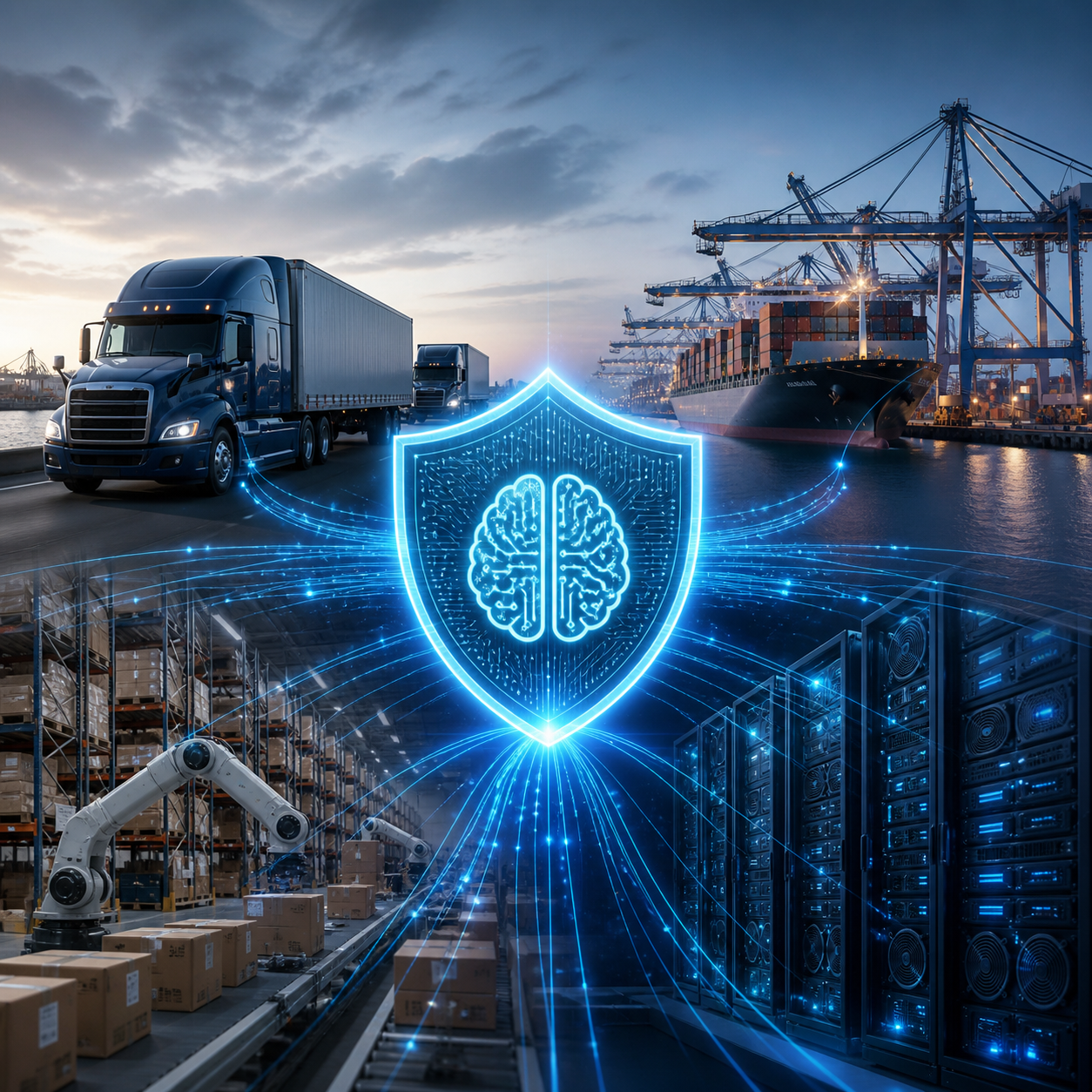
On September 15, 2025, Fleet Equipment Magazine published a piece titled “Trucks, Ports, and GPUs: Why AI in Logistics Requires a Whole New Network Playbook.” The article focuses on a simple but important point: as logistics organizations adopt AI, they are no longer just buying software features. They are redesigning the way data moves across trucks, ports, warehouses, and cloud systems.
The source frames AI in logistics as a security and networking challenge, not only a model or analytics challenge. That matters because logistics workflows depend on constant communication between field devices, operational systems, and compute infrastructure, including GPU-backed workloads that process large volumes of data.
The practical problem is that older network assumptions do not fit this environment well. If connectivity is inconsistent, if security is bolted on late, or if operational data cannot move fast enough, then AI outputs become less trustworthy and the business value drops quickly.
For operators, the question is therefore not whether AI can be deployed, but whether the underlying platform can support it in real conditions. That is where network design, segmentation, identity controls, observability, and reliability engineering become part of the AI strategy itself.
The Network Is Now Part of the Product
The article’s emphasis on SD-WAN and SASE reflects a broader shift in logistics technology: the network is no longer invisible plumbing. It is part of the operating product, because the quality of routing, data access, and policy enforcement directly affects how well AI-enabled workflows perform.
When trucks, ports, and back-office platforms all contribute to the same decision loop, data latency becomes a business issue. A delayed sensor update, a broken connection, or a weak policy boundary can affect dispatch, dock operations, and customer visibility at the same time.
This is why connected-device programs need to be designed as systems, not as isolated gadgets. At Paw Partners, that mindset aligns with electronic prototyping, IoT integration, and platform workflows that connect device data to dashboards and automation layers in a controlled way.
Security and Reliability Must Be Built Together
AI expands the attack surface because it increases the number of systems that need access to sensitive operational data. In logistics, that data often includes location information, asset status, shipment movement, and infrastructure telemetry, so access control and trust boundaries matter as much as model quality.
Security also cannot come at the expense of uptime. If controls are too rigid or if network policies are not designed for operational resilience, teams may create unsafe workarounds that move data outside the intended platform.
The source’s focus on modern networking suggests that the right approach is to treat reliability and protection as a single design problem. Secure access, consistent segmentation, and monitored traffic paths help ensure that AI outputs are based on complete and current data rather than partial or stale inputs.
What This Means for Connected Device Programs
Logistics AI becomes useful when data from field devices, terminals, and software systems can be trusted end to end. That requires a clear device-to-cloud architecture, with well-defined ingestion paths, failure handling, and observability across each step of the workflow.
Teams should validate not just the happy path, but also outages, reconnect behavior, and degraded modes. In practice, that means testing what happens when a truck loses coverage, when a port system queues updates, or when a dashboard must continue operating with partial data.
For organizations building operational platforms, this is where engineering discipline pays off. Strong integration patterns, durable data pipelines, and transparent dashboards help AI support real decisions instead of creating another layer of noise.
A Practical Path Forward
The article points toward a useful operating principle: start with the network and the data path, then layer AI on top. That sequence is more dependable than adding intelligence first and trying to secure or stabilize the environment later.
For Paw Partners, the opportunity is to help logistics clients prototype connected systems that are built for production realities. That includes software workflows that can survive interruptions, automation that reduces manual handling, and dashboard logic that presents trustworthy operational status.
In B2B terms, the business case is straightforward. Better network design improves data quality, and better data quality improves AI usefulness, which in turn supports faster decisions, fewer manual exceptions, and stronger operational control.
Source: Fleet Equipment Magazine