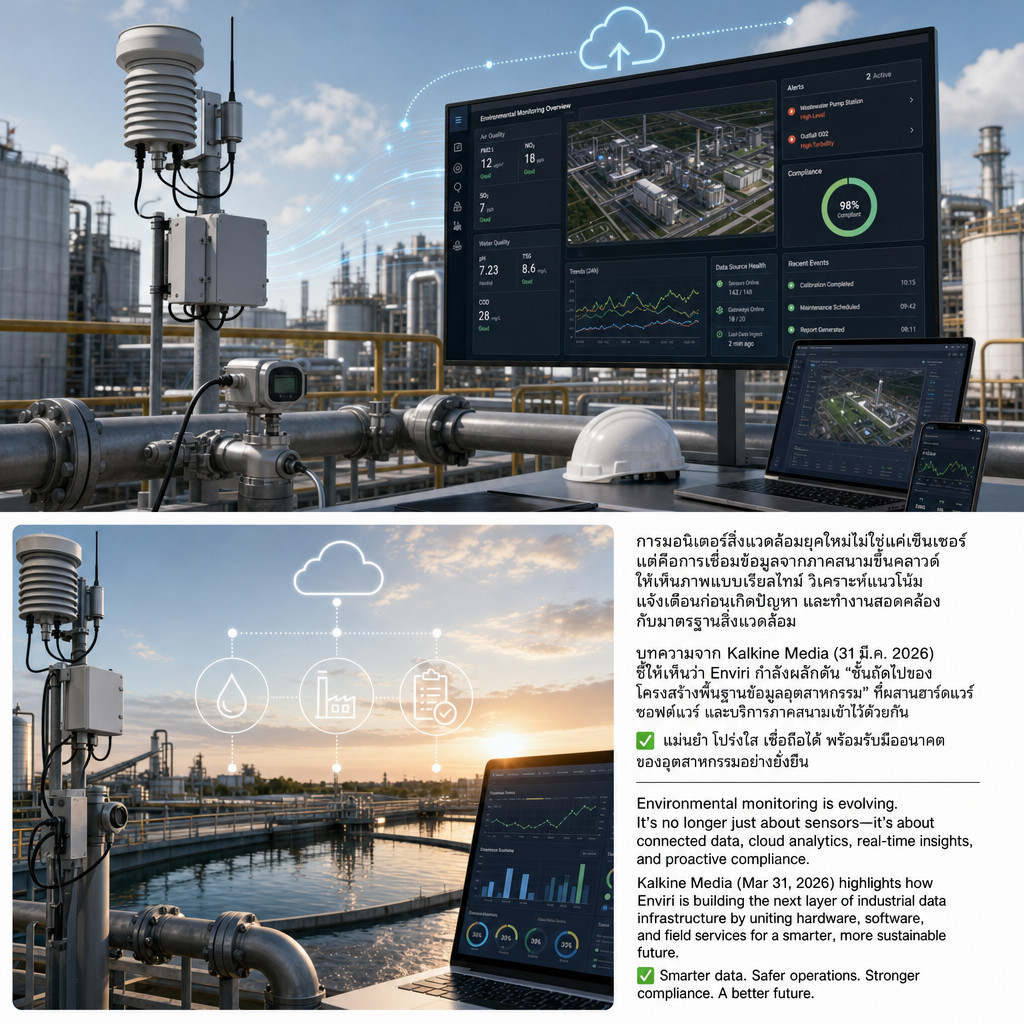
Kalkine Media’s March 31, 2026 article on Enviri focuses on a familiar but still difficult industrial problem: how to turn environmental conditions into reliable, usable operational data. The piece presents Enviri as a provider of environmental monitoring and data intelligence solutions for industrial operations and critical infrastructure systems, with a business model built around sensors, cloud analytics, field services, and visualization.
The timing matters because environmental monitoring is no longer treated as a narrow compliance function. Industrial operators are under pressure to track air quality, water composition, and wastewater flow continuously, then prove that those measurements are accurate, auditable, and actionable. That pushes the work beyond standalone devices and into integrated data infrastructure.
The article also makes a broader point about the market: companies in this space win when they can connect hardware and software into a dependable workflow. Sensors alone do not solve the problem. The value comes from transmission, processing, trend analysis, dashboards, and the operational discipline required to keep the system working in the field.
For teams building connected systems, the Enviri example is useful because it reflects a common enterprise engineering challenge. The technical burden is not simply capturing readings. It is making sure distributed devices feed a cloud platform, that the platform presents data in a form operators can trust, and that the overall system supports maintenance, calibration, reporting, and compliance at scale.
What The Article Says About Enviri’s Platform
The source describes Enviri as combining sensor hardware, cloud-based analytics, and field services into an environmental intelligence platform. In practical terms, that means the company is not selling isolated instruments. It is offering a system that can collect measurements, move them into software, and present them to industrial users in a way that supports daily operational decisions.
The article emphasizes real-time monitoring across air, water, and wastewater systems. That framing is important because environmental data is only useful when it arrives fast enough to influence action. Delayed or fragmented readings reduce the value of the system and increase the risk that operators will miss a threshold breach, a trend shift, or a maintenance issue.
It also notes that Enviri provides installation, maintenance, and calibration support. That matters because industrial monitoring systems are exposed to harsh environments, long operating cycles, and ongoing drift. A durable solution needs service workflows, not just devices. In B2B deployments, the operational model is often as important as the sensor specification.
Why Data Flow Matters More Than Raw Measurements
From an engineering perspective, the article points to a broader pattern in industrial technology: the measurement layer is only the first step. Once the data is captured, it must be transmitted reliably, normalized, stored, visualized, and retained for reporting. That makes the platform architecture as critical as the physical sensor network.
This is where connected-device design becomes a business issue. Industrial customers need systems that can handle intermittent connectivity, remote locations, and mixed device fleets without losing integrity. They also need dashboards and alerts that help operators prioritize action rather than simply display raw data. Those requirements map directly to the kinds of workflows Paw Partners builds around IoT integration, device telemetry, software systems, and operational dashboards.
The article’s focus on cloud analytics and historical trend analysis reflects another important need: environmental monitoring is not just about momentary readings. Operators need to compare current conditions with prior behavior, identify anomalies, and produce reports that stand up to internal review or external scrutiny. That requires consistent schema design, data governance, and automation across the reporting pipeline.
What This Means For Industrial Product Teams
For product and engineering teams, the takeaway is that environmental monitoring platforms must be designed as end-to-end systems. Device reliability, backend ingestion, alert logic, dashboard usability, and service processes all need to work together. If any layer is weak, the entire compliance and operations workflow becomes fragile.
The article also shows why industrial software must be built for maintainability. Calibration, diagnostics, field service coordination, and historical auditability are not side features. They are core product requirements when customers depend on the system to manage regulated operations. That is especially true in sectors where production, utilities, and infrastructure all depend on a high level of operational confidence.
For organizations looking to modernize this kind of stack, Paw Partners’ strengths line up well with the problem set highlighted here: electronic prototyping for connected devices, IoT integration, software platforms, dashboard design, and workflow automation. Those capabilities help convert sensor deployments into managed systems that are easier to operate, scale, and support over time.
Source reference: Kalkine Media - Enviri Advances Environmental Monitoring Capabilities Across Industrial Markets