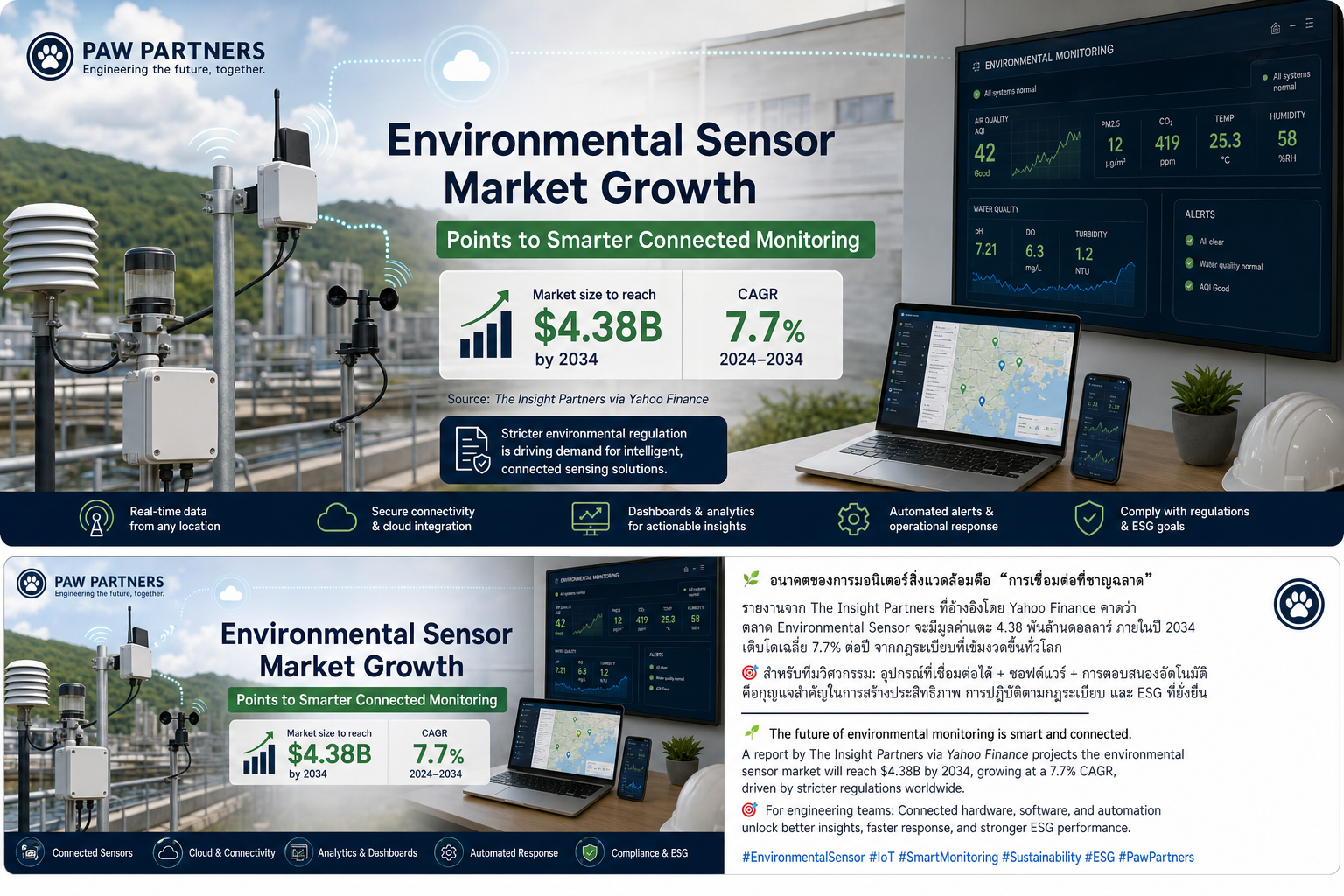
On April 2, 2026, a Yahoo Finance item highlighting research from The Insight Partners framed the environmental sensor market as a category that is still expanding, with a projected value of $4.38 billion by 2034 and a compound annual growth rate of 7.7%. The headline driver was not just technical curiosity about sensing hardware, but a clear market pull from stricter environmental regulations and the need to measure, document, and act on real-world conditions more consistently.
That matters because environmental sensing is no longer a standalone hardware story. Buyers increasingly expect devices to connect to software, stream data reliably, and support operational decisions in near real time. In other words, the value is shifting from a sensor that detects a condition to a system that turns that condition into a workflow, alert, report, or intervention.
The broader business problem is familiar across industrial, commercial, and infrastructure settings: environmental data is only useful if it is captured accurately, transmitted securely, organized clearly, and routed into the right operational process. Without those layers, teams end up with fragmented readings, manual spreadsheet work, and slow responses to compliance or safety issues.
For companies building products in this space, the implication is practical. The next wave of differentiation will come from connected devices, embedded software, analytics, and reliability at the system level. That is where Paw Partners' strengths in electronic prototyping, IoT-enabled systems, dashboards, and automation become directly relevant.
Why regulation is shaping demand
Environmental regulation tends to create durable demand because it turns measurement into a recurring operational requirement. Organizations cannot simply deploy a sensor once and consider the problem solved; they need dependable monitoring over time, traceable records, and a way to prove that thresholds were observed and acted upon.
That pushes product teams toward solutions that are easier to audit and easier to maintain. A sensor network that sends structured data into a dashboard, stores history, and issues alerts when conditions drift is more useful than a device that only logs locally or requires manual retrieval.
It also changes procurement decisions. Buyers are not only evaluating accuracy and durability; they are looking at integration effort, reporting quality, and how much operator time the system will save. In regulated environments, software can be as important as the sensor itself.
Where connected devices add value
Once a sensor is connected, the product can do more than observe. It can support remote visibility, coordinate multiple sites, and reduce the delay between detection and action. That is especially important for environmental conditions that move quickly or require prompt escalation.
Well-designed IoT architectures also help product owners separate device concerns from application concerns. The device can focus on measurement, power management, and communications, while the software layer handles user access, alert rules, analytics, and reporting. This separation makes the system easier to scale and maintain.
Paw Partners typically approaches this kind of program by linking electronic prototyping with cloud-aware software workflows. That combination matters because it shortens the path from bench testing to field deployment and reduces the risk of discovering integration issues only after devices are already installed.
What engineering teams should build next
For teams entering or expanding in this market, the strongest product strategy is usually system-oriented. Start with a reliable sensor and communication path, then build the software layer that converts raw measurements into decisions, exceptions, and evidence.
- Define the critical measurement points and sampling cadence before finalizing hardware.
- Design for connectivity resilience so data is not lost when networks degrade.
- Use dashboards that make trends and exceptions obvious to operators.
- Automate alerts, routing, and reporting so teams do not rely on manual review.
That approach improves both usability and defensibility. A product that can show historical patterns, surface anomalies, and document responses is easier to justify in compliance-heavy environments and easier to expand across sites or customer segments.
It also creates a better foundation for future features. Once data is structured and centrally available, teams can add predictive analytics, maintenance triggers, and workflow integrations without redesigning the whole system. That is where connected environmental sensing becomes a platform rather than a device.
Why reliability is part of the product
Environmental monitoring systems are often judged by what happens during edge cases: power interruptions, sensor drift, communication dropouts, or operator handoffs. If those moments are not handled cleanly, the entire solution loses credibility even if the base measurements are accurate.
That is why reliability needs to be engineered across the stack. Hardware must be testable, firmware must be maintainable, software must be observable, and dashboards must remain usable under real operating conditions. The best systems are built for the reality of field deployment, not just for demo performance.
This is also where operational workflow design becomes essential. When alerts feed into the right team, acknowledgments are tracked, and corrective actions are visible in one place, environmental sensing stops being passive reporting and becomes an operational control layer.
Source: Yahoo Finance via Google News reporting on The Insight Partners research, published April 2, 2026.