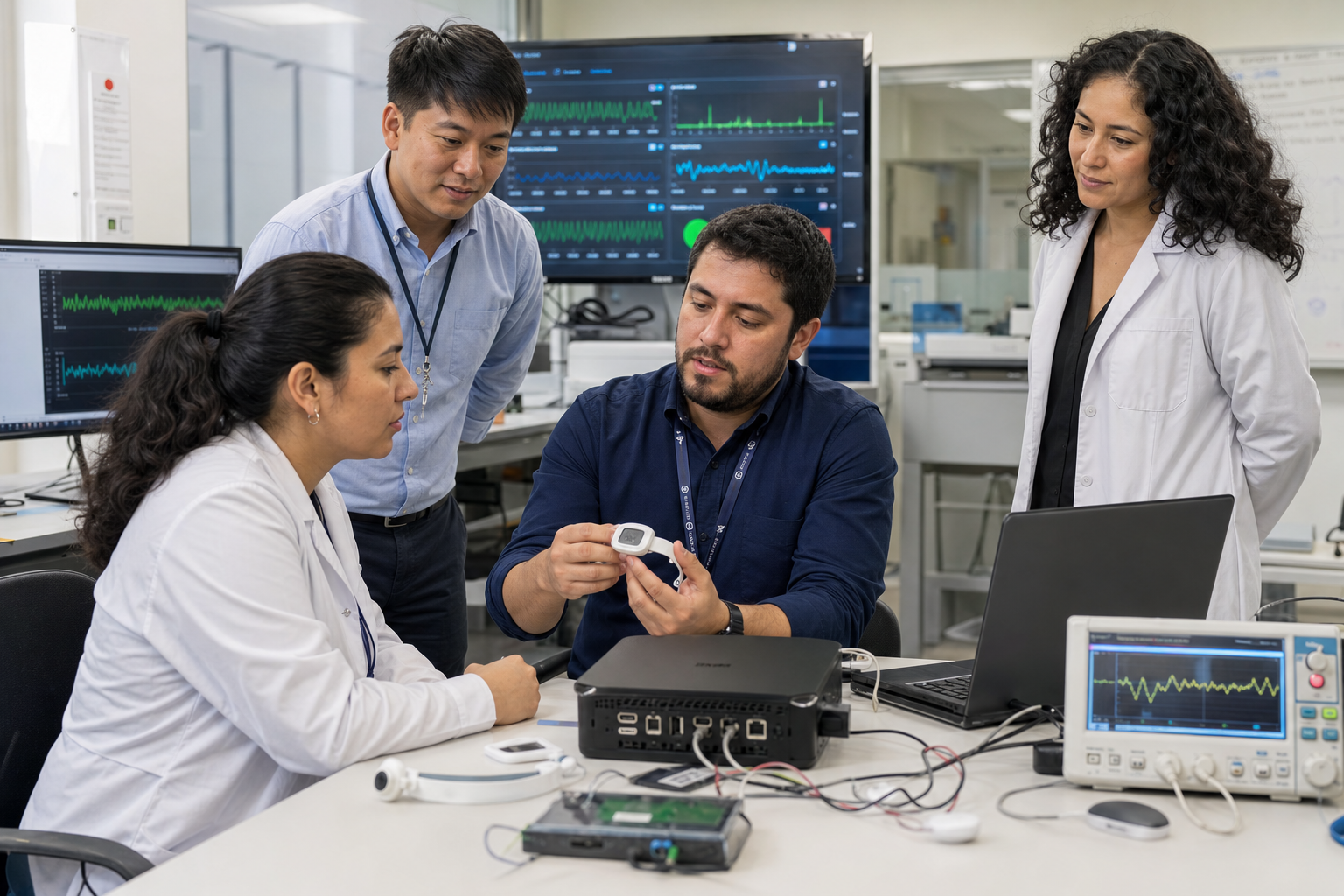
Introduction to Edge-AI in Healthcare IoT Systems
Recent advancements in wireless IoT technologies combined with Edge Artificial Intelligence (Edge-AI) have opened new possibilities for real-time healthcare monitoring. These systems promise continuous patient data collection and immediate anomaly detection without latency caused by cloud communication. However, building effective Edge-AI healthcare solutions requires secure architectures that ensure data integrity, privacy, and operational resilience.
Challenges in Secure Wireless IoT Architecture and Data Reliability
Healthcare IoT devices must operate under strict regulatory and security requirements. Wireless connectivity introduces vulnerabilities such as data interception and device spoofing. Furthermore, IoT device data can suffer from noise, loss, or inconsistencies, which directly impact the accuracy of AI algorithms running on edge devices. Ensuring strong device data requires both hardware-embedded security features and optimized software workflows that handle data validation, preprocessing, and anomaly filtering.
Federated Anomaly Detection and Software Workflow Coordination
Federated learning and anomaly detection allow aggregated insights from distributed edge devices while maintaining patient data privacy. Coordinating these workflows over a trustworthy operational platform ensures that AI models are updated steadily without exposing sensitive information. A well-designed system must balance computational resource constraints on edge nodes with the need for reliable model inference and prompt detection of healthcare anomalies.
Conclusion
Edge-AI integrated secure wireless IoT architectures represent a promising direction in enhancing healthcare monitoring with real-time, reliable insights. Achieving practical deployment, however, requires meticulous attention to device data quality, robust software workflows, and trustworthy operational infrastructures that adhere to security and privacy standards.
For many organizations, events like this expose the same architectural weakness: data may exist, but it is not yet connected to a dependable operational process. Without that connection, teams see the issue too late or respond inconsistently across locations.
A practical engineering response should treat Nature as a signal, not just a news item. The goal is to translate lessons from the event into clearer device telemetry, stronger automation rules, and dashboards that support decisions under real operating conditions.