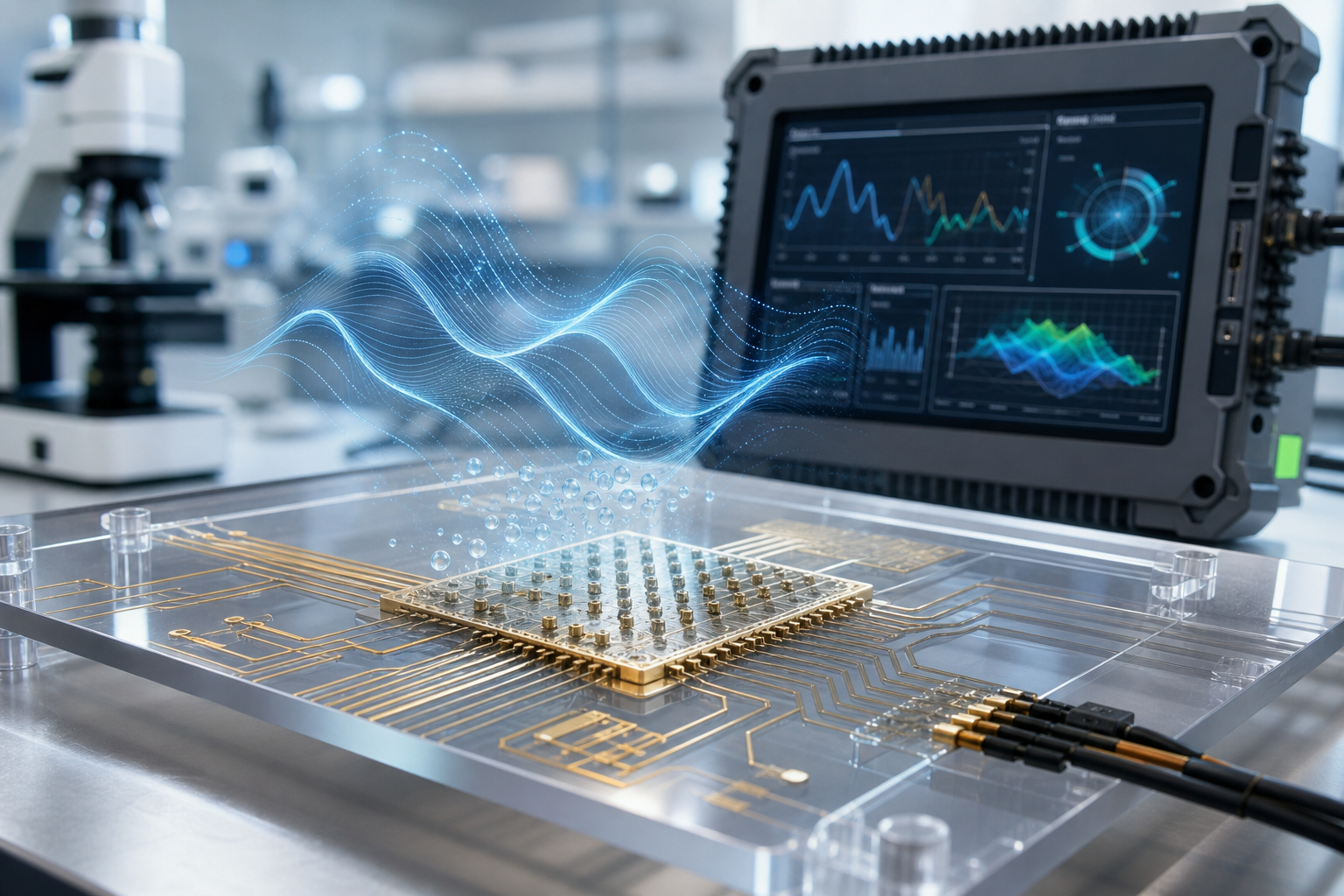
On April 9, 2026, researchers in India reported a neuromorphic humidity sensor that is designed to behave less like a passive component and more like a simple biological system. The device responds to environmental moisture while also showing memory-like and processing-like behavior, which makes it an unusual step forward in smart sensing hardware.
The work was led by scientists at the Jawaharlal Nehru Centre for Advanced Scientific Research (JNCASR), an autonomous institute under India’s Department of Science and Technology, and was published in Journal of Materials Chemistry C. According to the report, the team built a single-platform sensor that integrates sensing, memory, and processing rather than splitting those functions across separate parts.
That matters because conventional sensor systems often send raw measurements to separate processing units, which increases latency, energy use, and data-transfer overhead. In IoT deployments, industrial monitoring, and edge AI systems, those costs accumulate quickly and can become the limiting factor long before the sensing hardware itself fails.
For product teams building connected devices, the lesson is practical: the architecture of the sensing stack can shape power budget, responsiveness, and operational reliability as much as the firmware or dashboard layer. Devices that can filter, adapt, and respond locally can reduce cloud dependence and simplify telemetry workflows.
What the device demonstrates
The sensor is described as humidity-responsive and brain-like because it does more than register moisture changes. The reported behavior includes synaptic facilitation, synaptic depression, metaplasticity, and basic logic operations, all of which point to a device that can change its response based on prior exposure.
That kind of adaptive behavior is important in edge systems where the goal is not simply to capture data, but to interpret patterns in place. For operational monitoring, that can help separate meaningful environmental shifts from background noise and reduce unnecessary upstream traffic.
How it was built
The device uses 1D supramolecular nanofibers synthesized from charge-transfer complexes of donor and acceptor molecules. Those nanofibers were deposited on interdigitated gold electrodes on a glass substrate to form the active sensing layer.
In testing, the researchers applied controlled humidity pulses with different strengths and intervals while measuring electrical responses. The report also notes that light influences the device’s behavior, reflecting the way cricket frogs respond to moisture and daylight in nature.
That combination of chemistry, materials engineering, and stimulus control shows why neuromorphic hardware is a systems problem, not just a materials problem. Real products need repeatable fabrication, stable calibration, and software that can interpret changing device behavior over time.
Why it matters for connected systems
The broader promise is lower energy use with less data movement. If sensing, memory, and processing are integrated in one device, the system can avoid some of the overhead that normally comes from constantly shuttling raw sensor data between components.
That is relevant for environmental monitoring, wearables, automation platforms, and IoT endpoints that must operate for long periods with minimal maintenance. It is also relevant for dashboard design, because better local signal handling can produce cleaner alerts and reduce alert fatigue for field teams.
From a platform perspective, this is the same problem many industrial systems face: devices are easy to deploy at pilot scale, but expensive to run when every reading has to be stored, transmitted, and evaluated centrally. Paw Partners’ work in electronic prototyping, connected devices, and software workflows aligns with this kind of challenge, where hardware behavior, telemetry, and alerting must work as one system.
What teams should watch next
The article positions this research as a step toward smarter, more sustainable electronics, but it is still early-stage research. The real test will be whether the device can be translated into manufacturable hardware with stable behavior across real environments.
For engineering leaders, the key questions are familiar: can the sensing response be calibrated, can the device tolerate field conditions, can telemetry be integrated into dashboards, and can maintenance be automated without adding complexity? Those are the questions that separate laboratory novelty from production utility.
Source: Devdiscourse report. The official Department of Science and Technology note is available at DST India.