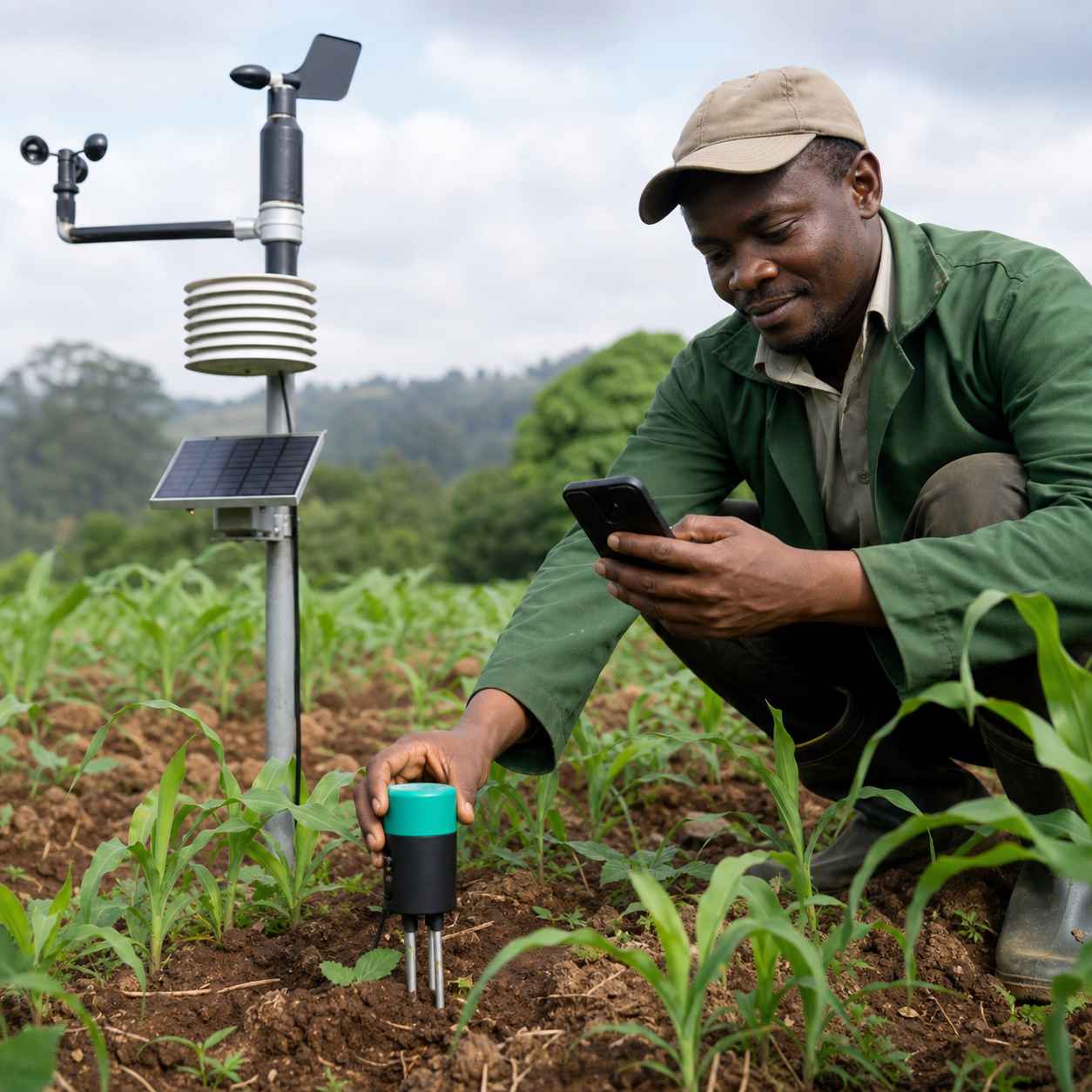
On April 18, 2026, Devdiscourse highlighted a shift that matters well beyond agriculture technology circles: low-cost field sensors are making precision farming more accessible to smallholder farmers. The core idea is straightforward, but the operational impact is not. When sensing, monitoring, and basic analytics move from premium installations to affordable deployments, the technology stops being a luxury and starts becoming a working tool.
The business problem behind the story is familiar in connected systems. Many farms can benefit from better visibility into moisture, temperature, field conditions, and equipment health, yet the cost and complexity of traditional precision farming tools often keep them out of reach. Smallholders usually need simple systems that are rugged, easy to deploy, and easy to maintain, not expensive platforms that depend on specialist support.
That is why the sensor discussion matters. A lower-cost device is only the first step. The larger value comes from telemetry pipelines, health alerts, dashboards, and workflows that help farmers and field operators act on data before yield, uptime, or input efficiency is affected. This is where product design and field operations intersect.
For companies building agricultural technology, the source points to a broader engineering lesson: affordability has to be designed into the full stack, from hardware selection to connectivity, data handling, and serviceability. Paw Partners works in exactly this space, where electronic prototyping, IoT-connected devices, platform workflows, and reliable monitoring systems turn field data into operational decisions.
Why Lower-Cost Sensors Change the Adoption Curve
Precision farming has long been associated with advanced equipment and high capital spending. That model fits large commercial operations, but it creates a barrier for smaller farms that need practical gains without a heavy upfront investment. Lower-cost sensors reduce that barrier by making it possible to start with focused use cases rather than full-scale automation.
For smallholders, the value is not abstract. If a system can track a few critical variables and show when conditions drift out of range, the farmer can irrigate more precisely, inspect a field earlier, or avoid unnecessary input use. Those are modest technical wins that can translate into real operational savings.
The important shift is incremental adoption. Small farms rarely need a complete digital transformation on day one. They need a path to begin with a few sensors, prove the value, and expand only after the process is trusted. That makes modular hardware and software architecture especially important.
Telemetry Is Where the Real Value Appears
A sensor by itself does not solve a field problem. The value appears when the device is connected to a system that can collect readings, normalize them, store them, and trigger action when thresholds are crossed. Without that layer, the deployment becomes another isolated gadget instead of an operational tool.
This is where device telemetry matters. Stable data flows make it possible to compare conditions across plots, identify trends over time, and spot exceptions early. In practice, that can mean fewer surprise failures, better irrigation timing, and faster response when equipment or environmental conditions change.
Health alerts are equally important. If a device loses power, drops offline, or begins reporting anomalous readings, operators need to know quickly. Alerting reduces downtime because it narrows the gap between failure and intervention. For distributed agricultural deployments, that gap is often the difference between a small fix and a lost cycle.
Dashboards and field workflows give the data context. A clean interface can show what needs attention now, what can wait, and what has already been resolved. For teams responsible for multiple locations, that operational clarity is often as valuable as the sensing itself.
Reliability, Maintenance, and Scale Matter More Than Demo-Day Features
In the field, sensors have to survive heat, dust, moisture, intermittent connectivity, and irregular maintenance cycles. That reality changes the product requirements. Rugged enclosures, efficient power design, secure firmware updates, and offline-tolerant data handling are not premium features; they are baseline requirements for dependable operation.
Smallholder deployments also need systems that are serviceable by local teams. If a device fails and there is no clear path to diagnose it, replace it, or restore service, the total cost of ownership rises quickly. Well-designed monitoring platforms reduce this risk by making faults visible early and by giving operators the information they need to act without guesswork.
Scale should be planned around repeatability, not complexity. The best agricultural systems are often the ones that can be replicated across farms with minimal reconfiguration, supported by standard hardware patterns and consistent software workflows. That is the kind of architecture that helps a pilot program become an operating business.
For Paw Partners, the opportunity is to connect prototypes to field-ready systems: sensor hardware, communications, dashboards, maintenance workflows, and integrations that make operations measurable. That is what turns precision farming from a promising concept into a dependable service model.
Source: Devdiscourse via Google News RSS, source link.