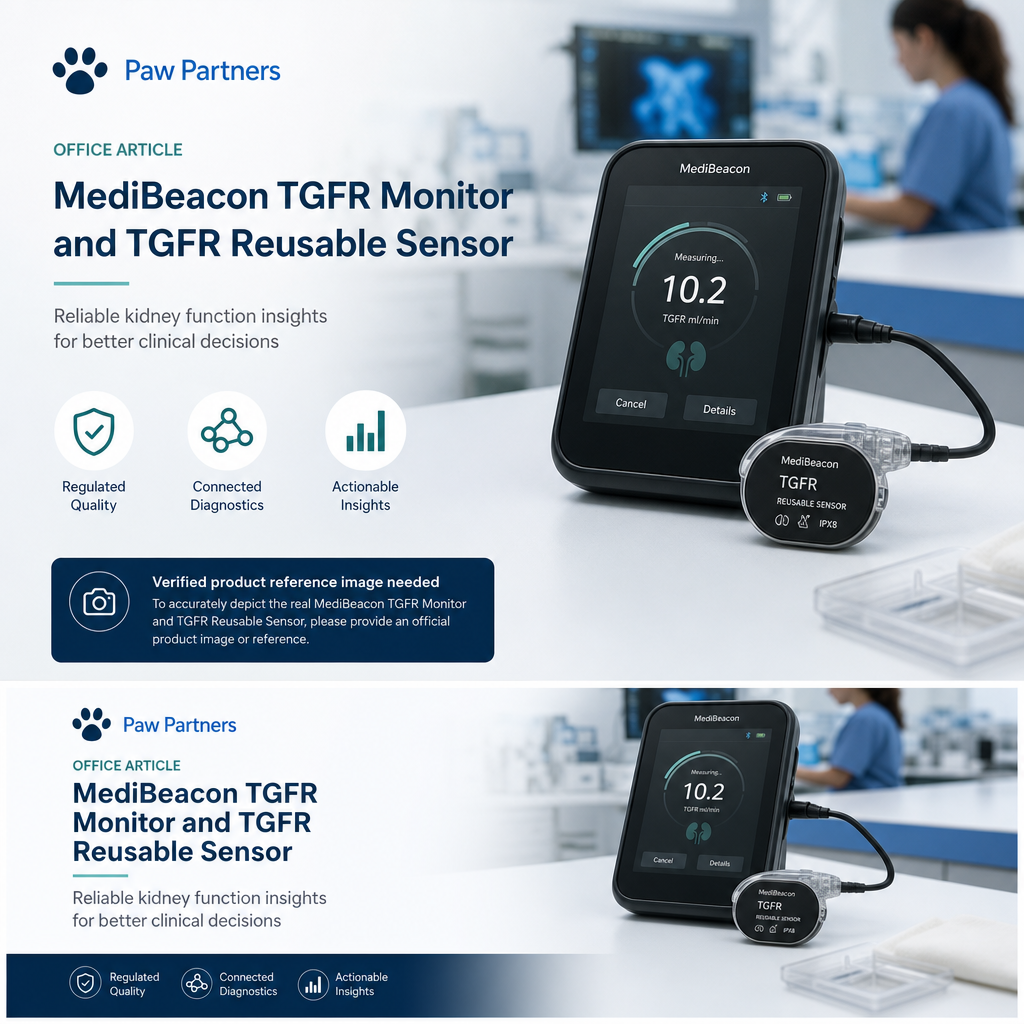
On March 31, 2026, MediBeacon announced that its TGFR Monitor and TGFR Reusable Sensor received European Union CE Mark certification under the EU Medical Device Regulation. The company, based in St. Louis, develops fluorescent tracer agents and transdermal detection technology for kidney-function assessment.
The release matters because it moves the TGFR platform further along the path from promising technology to regulated clinical product. The TGFR system combines the reusable sensor, the monitor, the TGFR Disposable Ring, and Lumitrace® (relmapirazin) injection to estimate glomerular filtration rate without a traditional blood draw.
According to the announcement, the TGFR Monitor and TGFR Reusable Sensor are now certified as two Class IIa devices under EU MDR 2017/745. The company also noted that Lumitrace is already approved in the U.S. and China, while submission to European regulators is still pending.
For engineering teams, the real lesson is not just regulatory. A product like this is only useful if it delivers repeatable readings, clear workflow integration, traceable device status, and dependable operation across clinical settings. That is the same challenge seen in other connected-device programs: the sensor is only one part of the product; telemetry, data handling, support workflows, and maintenance matter just as much.
What The CE Mark Changes
The CE Mark signals that the TGFR Monitor and TGFR Reusable Sensor have met the safety, quality, and performance expectations required by the EU MDR. That does not make commercialization automatic, but it does establish a stronger foundation for European clinical use and future expansion.
The company said the certification could support the use of transdermal GFR technology in clinical trials that include European sites. In practical terms, this is where product engineering and regulatory engineering overlap: design controls, verification evidence, risk management, and documentation all need to be aligned before a platform can move across borders.
For teams building connected diagnostics, that alignment is often where projects stall. A hardware prototype can be promising, but a regulated product needs version control, auditability, lifecycle support, and software behavior that can be explained and defended. That is where platform workflows and structured monitoring become part of the product itself.
Why Reusable Hardware Raises The Bar
MediBeacon’s release notes that the TGFR Reusable Sensor records 2.5 fluorescent readings per second, while the monitor displays the average session tGFR reading at the point of care. That combination of reusable hardware and ongoing data acquisition creates a higher bar for consistency than a single-use disposable device.
Reusable systems introduce operational questions that many product teams underestimate. How is the device tracked between sessions? How are status, calibration, and service needs surfaced to the operator? How is signal quality monitored over time so the team can tell the difference between a device issue and a clinical issue?
Those questions are where telemetry and health alerts become operational tools, not just features. A monitoring dashboard can reduce downtime by making device health visible early, while workflow automation can route exceptions to the right support team before the issue disrupts patient care.
- Asset visibility helps teams know which devices are in use and which need service.
- Health alerts can flag degraded performance before it affects readings.
- Integration with support workflows shortens response time when a device is offline.
- Audit trails make it easier to prove what happened during a clinical session.
What Product Teams Can Learn
The most important part of the announcement is that MediBeacon is not shipping a standalone sensor story. It is building a system: reusable sensor, monitor, disposable ring, tracer agent, algorithms, and a regulatory framework that spans multiple markets. That is the shape of modern connected medtech.
The release also shows how commercialization happens in stages. The company says the TGFR system is entering the clinic in the U.S. and China, while the European path is advancing through CE Mark certification and pending submission of Lumitrace to EU regulators. In other words, the product roadmap is as much about geography and compliance as it is about technical performance.
For companies working with Paw Partners, this is a familiar pattern. Electronic prototyping, connected-device firmware, software systems, dashboards, and service workflows need to be designed together so the field experience is stable from the first deployment. If the product is regulated, reliability is not a nice-to-have; it is part of the commercial model.
The deeper engineering takeaway is simple: when a device becomes a platform, operations become part of product quality. The teams that succeed are the ones that can see device state, automate routine checks, and integrate field support before customers experience downtime.
Source: GlobeNewswire, MediBeacon® Transdermal GFR Monitor and Reusable Sensor Receive CE Mark Under European Medical Device Regulation.