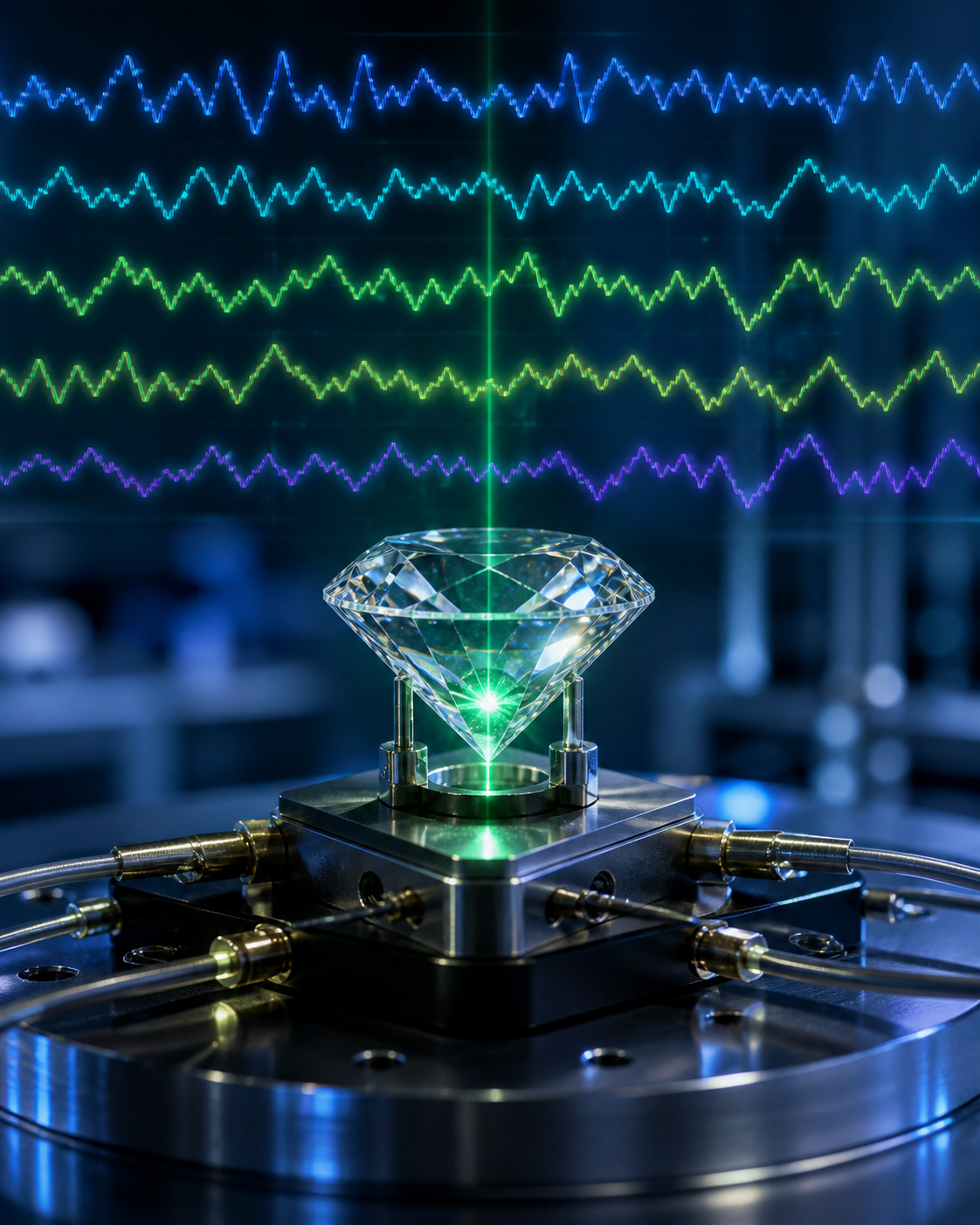
On April 15, 2026, MIT reported a quantum sensing result that is easy to miss if you only look at the physics headline. The team demonstrated a solid-state sensor that can measure multiple physical properties at once, rather than forcing operators to run separate experiments for each parameter. In the paper, the researchers used a diamond-based nitrogen-vacancy platform and entanglement-assisted readout to capture more information from a single measurement cycle.
The immediate scientific significance is clear: multiparameter sensing has been mostly theoretical, especially in practical, room-temperature systems. MIT’s work matters because it moves the idea from abstract quantum metrology into a sensor class that already has real-world relevance. The sensor was tested in a commonly used setup and shown to measure several properties of a microwave field in one pass, with better performance than measuring each property sequentially or using traditional sensors.
For engineering teams, the deeper lesson is not limited to quantum hardware. Any system that can extract more usable signal from the same device, without adding latency or ambiguity, changes how monitoring pipelines are designed. If one sensor can report multiple state variables reliably, the surrounding software stack must preserve context, reconcile measurements, and trigger the right operational response.
That is where the business problem becomes visible. Repeating measurements costs time, reduces sensitivity, and increases the chance of error. In connected products, field devices, and industrial systems, the same pattern shows up as wasted maintenance cycles, weak observability, and alerts that arrive too late or with too little context. MIT’s result is a reminder that better sensing and better telemetry are tightly linked.
Why the result matters
The MIT team’s approach uses entanglement to let two qubits behave as a coordinated measurement system. In practical terms, that gives the sensor more than one way to encode and recover information from the same physical environment. The paper shows that the sensor can recover multiple parameters from a microwave field in a single measurement, which is the kind of capability that changes how tightly a platform can observe reality.
That matters because many sensing systems still behave like isolated gauges. One reading for temperature, one for strain, one for field strength, then another pass to reconcile them. In a real deployment, each extra pass adds delay and introduces more opportunities for drift, noise, and operator error. A multiparameter sensor reduces that overhead by concentrating signal capture into one coordinated measurement step.
Engineering implications for connected systems
For product teams building connected devices, the relevant analogy is telemetry density. A device that reports richer state in a single, well-structured payload is easier to monitor than a device that emits fragmented signals across multiple channels. The same is true in software systems: observability improves when metrics, events, and health indicators arrive with consistent timing and clear relationships.
Paw Partners works in the space where that relationship becomes operational. Electronic prototyping, IoT-connected hardware, dashboards, and automation only create value when data can move from the device to the platform without losing meaning. A sensor innovation like MIT’s raises the bar for the rest of the stack: ingestion, normalization, historical trending, and alert logic all have to handle more nuanced inputs.
The article also highlights a practical engineering constraint: signal overlap. MIT noted that many solid-state quantum sensors struggle when two external effects shift the same resonance in similar ways. That is not unique to quantum systems. It is a common failure mode in production telemetry, where one alert symptom can be caused by multiple underlying issues unless the platform is designed to separate them.
What operational reliability looks like
MIT’s result is especially useful because it was demonstrated at room temperature in a solid-state sensor, not only in an idealized lab scenario. That makes the work more relevant to applications where field conditions, packaging constraints, and environmental variability matter. In deployment terms, the lesson is straightforward: practical sensing wins when the device and the software are designed together.
That design principle maps directly to monitoring platforms and health alerts. If a system can infer more from fewer measurement cycles, the platform can surface earlier warnings, reduce unnecessary retries, and support better maintenance decisions. The value is not just in collecting more data, but in making that data actionable before a failure turns into downtime.
MIT’s research also suggests a useful path for future product development: separate the sensing problem from the analytics problem, but connect them tightly. The hardware should capture the richest possible signal, while the platform should classify, correlate, and route that signal into workflows that operators can trust. That is the same architecture behind reliable industrial dashboards, predictive maintenance, and connected device fleet management.
For teams building physical products, the takeaway is not to wait for quantum hardware to mature before rethinking telemetry. It is to design for richer measurement now: cleaner data models, better time alignment, and alerting that understands relationships between parameters instead of treating every signal as isolated. MIT’s sensor is a research milestone, but the system lesson applies immediately.
Source: MIT News, “Multitasking quantum sensors can measure several properties at once”.