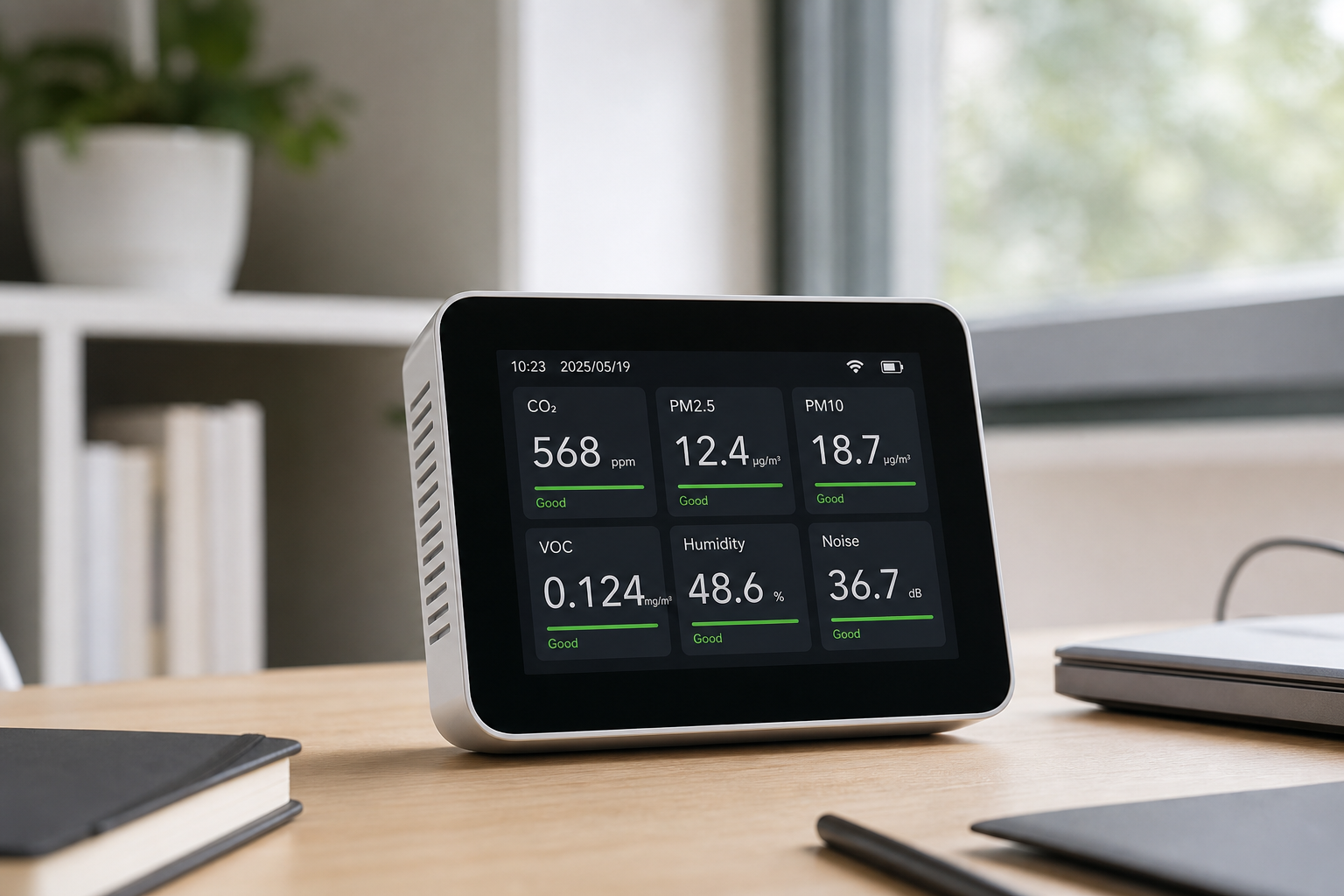
In late March 2026, BreatheSafeAir published a detailed review of the Qingping Air Quality Monitor Gen 2, following up on a first-generation device the reviewer had already rated highly. The central question is straightforward: if the original monitor was already strong, what does the second generation actually improve, and is the extra cost justified?
The answer in the review is not a simple spec-sheet upgrade. Qingping added a larger 4-inch touchscreen, a replaceable PM sensor module, PM10 and noise measurements, an alarm clock function, and updated sensor components, including Sensirion parts for VOC and CO2 measurement. The review also makes clear that the core particulate sensor remains the same family as before, which keeps the discussion grounded in practical performance rather than marketing language.
That matters because indoor air quality monitors are only useful when the reading is easy to understand and easy to act on. The reviewer highlights a device that can stand alone on a desk, be configured without a phone, and still connect to apps when needed. For organizations, that combination is important: a local display for immediate awareness and connected software for records, trends, and team visibility.
From a business and engineering perspective, the real problem this product addresses is turning environmental data into operational decisions. If a device can surface changes in CO2, particles, or VOC trends clearly, it becomes more than a gadget. It becomes part of a monitoring workflow that can inform ventilation adjustments, maintenance priorities, and occupant comfort decisions. That is exactly the kind of use case where Paw Partners-style connected-device systems, dashboards, automation, and alerts can add value.
What Gen 2 Changes From Gen 1
The review says Gen 2 is meaningfully different from Gen 1 in the areas that matter most to everyday use. The screen grows from 3.1 inches to 4 inches, the PM sensor becomes replaceable, PM10 and noise measurements are added, and an alarm clock feature is included. The VOC sensor moves from the SGP30 to the SGP40, and the CO2 sensor becomes the Sensirion SCD40.
- 4-inch touchscreen instead of 3.1 inches
- Replaceable particulate sensor module
- PM10 measurement enabled
- Noise measurement added
- Alarm clock function added
- Updated VOC and CO2 sensors
The reviewer also notes that the noise sensor raises privacy questions, but Qingping says it measures sound energy rather than recording or uploading audio. The Gen 2 model is around $20 more expensive than the first generation, and the article suggests that the newer version is the better buy for new customers, even though Gen 1 remains a strong option.
Accuracy And Sensor Caveats
On measurement quality, the review is cautious but positive. The Gen 2 keeps the same PM2.5 sensor family as Gen 1, and the reviewer expects similar particulate performance because the hardware approach appears unchanged. The article also explains that the new PM10 readings are enabled from the same sensor rather than from a dedicated new component.
That detail matters because low-cost PM10 readings are often less dependable than PM2.5 readings. The review frames PM10 as a useful signal for trends rather than a precision metric, which is the right way to think about many consumer air-quality devices. The same caution applies to VOC values: the SGP40 reports a relative index, so the most useful insight is whether conditions are rising or falling compared with the device’s recent baseline.
For CO2, the review is more confident. The Gen 2 uses the Sensirion SCD40, and the reviewer compares its readings with an Aranet4 Home, a consumer monitor commonly treated as a benchmark. The two devices track closely, with differences staying within stated accuracy ranges. The reviewer also points out that the CO2 sensor can be calibrated manually, which helps maintain useful baselines over time.
Why The User Experience Matters
The strongest part of the review is not just measurement quality but usability. The monitor’s touchscreen is described as responsive and intuitive, making the device easy to use without relying on a companion app. The reviewer also notes that Wi-Fi setup can be completed on the device itself, which reduces friction for non-technical users.
That standalone experience has practical value in offices and shared spaces. The article mentions that the Qingping IoT app is better suited when a team needs to view the data, such as in an office building. In that context, the monitor becomes part of a broader operational system: local visibility on the device, shared visibility in software, and the ability to export data when teams need a record.
This is where connected workflows become important. A monitor that is easy to read is useful, but a monitor that feeds dashboards, scheduled reviews, and automated alerts is much more valuable for operations. Facilities teams can use that structure to respond faster to ventilation issues, identify recurring spikes, and coordinate with maintenance or building management more efficiently.
Pricing And Buying Judgment
The review places the Gen 2 in the mid-range category at roughly $150, which is about $20 more than the original monitor. Against cheaper devices, the Qingping stands out because of its display, usability, and standalone operation. Against more expensive monitors, it competes on practicality and user experience rather than on maximum sensor count.
The reviewer’s conclusion is balanced: if you already own Gen 1, there is not enough here to justify an upgrade. If you are buying for the first time, Gen 2 is the more compelling product because the added screen size, replaceable PM sensor, and extra measurements improve day-to-day usefulness. In other words, the value is in the workflow, not just the feature list.
For teams building product or facility monitoring systems, that is the important takeaway. Environmental sensing succeeds when the hardware is easy to live with and the software turns readings into action. Devices like the Qingping Gen 2 show how a good display, reasonable accuracy, and team-facing connectivity can support more reliable decisions across homes, offices, and managed spaces.
Source: Qingping Air Quality Monitor (Generation 2) Review - Is it Even Better? - breathesafeair.com