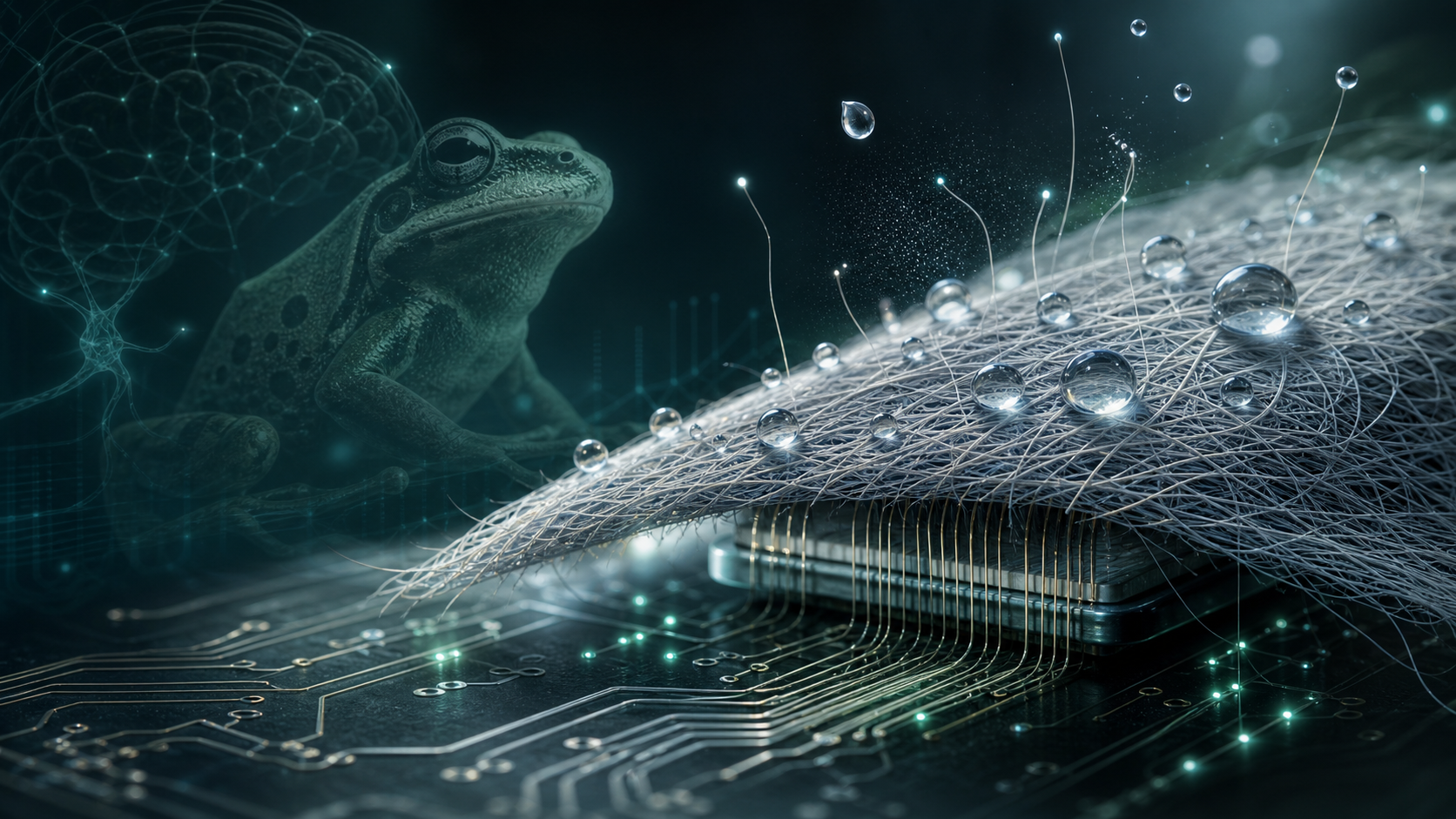
On April 9, 2026, India’s Department of Science and Technology (DST) highlighted research from the Jawaharlal Nehru Centre for Advanced Scientific Research (JNCASR) on a humidity-responsive neuromorphic sensor inspired by cricket frogs. The work sits at the intersection of materials science, bio-inspired electronics, and low-power computing.
The main engineering problem is familiar across connected products: conventional electronics usually split sensing, memory, and processing across separate components. That creates extra power consumption, data movement, and latency, which becomes expensive in edge devices that must run continuously and respond locally.
In this research, the team used one-dimensional supramolecular nanofibres to build a single device that can sense humidity and show synapse-like behavior. The sensor was reported in the Journal of Materials Chemistry C, and DST says it can respond to humidity pulses, retain short-term memory-like effects, and support basic logic operations.
For product and platform teams, the significance is architectural. If sensing and processing can be combined at the device layer, systems can reduce data-transfer overhead, simplify signal paths, and support always-on monitoring with lower energy cost.
What the device demonstrates
The reported sensor is based on a charge-transfer complex of coronene tetracarboxylate and dodecyl methyl viologen grown into one-dimensional supramolecular nanofibres. In the experiment, the fibres were coated onto interdigitated gold electrodes and tested in a humidity-controlled chamber.
According to DST and the journal abstract, the device responded to humidity pulses of different strengths and intervals and exhibited synaptic responses such as facilitation, depression, and metaplasticity. The researchers also showed light-enhanced synaptic response and basic logic operations, which are useful indicators for adaptive electronics research.
Why humidity matters in neuromorphic design
Humidity is usually treated as an environmental nuisance in electronics design, but in biological systems it can help shape neural behavior. This project uses that idea directly: the frog inspiration is practical, because cricket frogs show moisture-sensitive activity that the device was designed to emulate.
The device changes its electrical response as humidity changes, and DST notes that it can also temporarily remember previous humidity signals. That turns humidity from a condition to be ignored into an input that can drive state change, adaptation, and local decision-making.
Operational relevance for connected systems
In deployed systems, the best sensors are not the ones that collect the most data, but the ones that trigger the right action with minimal overhead. A humidity-responsive neuromorphic device points to event-driven monitoring models where a field node interprets local conditions before pushing data upstream.
That architecture aligns with the kinds of systems Paw Partners helps design and integrate: device telemetry, dashboard workflows, alerting logic, automation, and reliability layers that reduce downtime. Whether the use case is environmental monitoring, wearables, or industrial edge nodes, the business value comes from faster decisions and fewer unnecessary transmissions.
The article also highlights a systems-level tradeoff. Many neuromorphic sensors still depend on separate sensing and memory elements, which increases complexity and power use. Consolidating those functions into one adaptive platform can improve maintainability and make distributed deployments easier to operate.
This is especially relevant for field operations where humidity, temperature, and other environmental signals can be used to trigger alerts before they become failures. A well-designed monitoring stack can turn a device’s local signal into a clear operational workflow: capture, classify, alert, and act.
Source: Department of Science & Technology (DST). Reference paper: J. Mater. Chem. C, 2026, 14, 2264-2273.