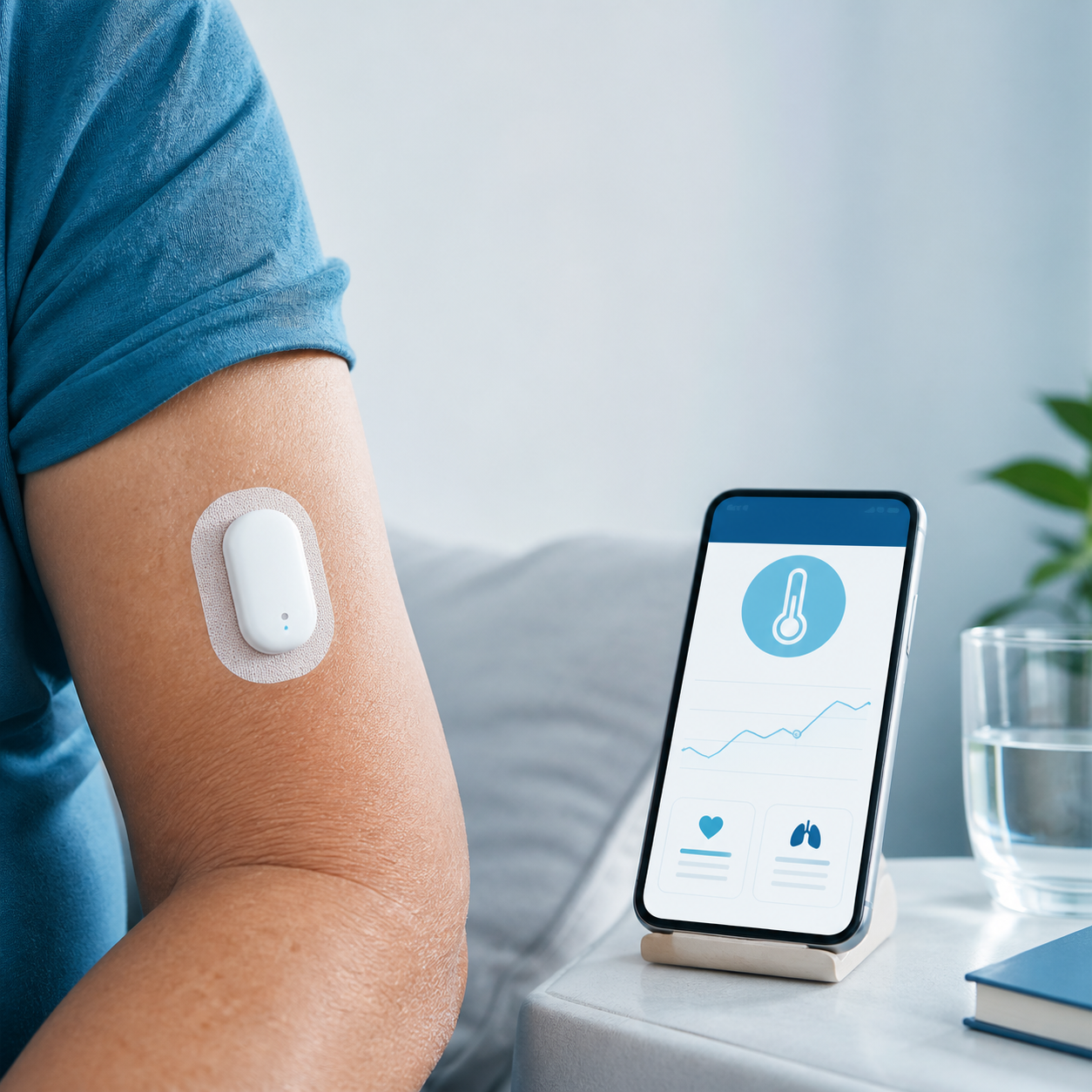
On April 17, 2026, IndexBox published a market outlook on wearable thermometers that places the category in a clear transition phase. The report does not describe a single breakthrough device or a sudden demand spike. Instead, it shows a market moving from a niche medical tool toward a more mainstream part of connected health systems.
The central theme is structural change in care delivery. Demand is being pulled by hospital-at-home programs, remote patient monitoring, and consumer interest in proactive wellness tracking. In practical terms, wearable thermometers are no longer just about spot checks for fever; they are becoming part of continuous monitoring workflows that generate data, alerts, and operational decisions.
The report also makes the market split visible. One side is a high-volume, lower-margin segment focused on basic temperature detection. The other side is a more premium category built around continuous insight, data connectivity, and predictive value. That split matters because it changes what buyers expect from the device, the app, the dashboard, and the backend systems that move data into clinical or consumer workflows.
For product teams, the engineering problem is broader than sensor accuracy. A wearable thermometer has to be comfortable, reliable, power-efficient, secure, and easy to integrate with the systems that receive the data. This is where connected-device architecture, API design, dashboard logic, and workflow automation become the difference between a disposable gadget and a device platform.
Why the Category Is Expanding
IndexBox ties demand to the broader shift toward decentralized healthcare. Hospital-at-home models and remote patient monitoring both reduce dependence on traditional bedside care, which creates room for devices that can collect useful signals without requiring constant in-person attention. Temperature is a foundational vital sign, so wearable thermometers fit naturally into these models.
The report also highlights consumer wellness behavior. Buyers increasingly want tools that help them monitor health proactively rather than react only when symptoms become severe. That makes the market less dependent on episodic illness and more tied to habit formation, personal health tracking, and family care routines.
There is also a clear clinical logic behind the adoption. Continuous temperature data can support earlier intervention, especially in settings such as post-operative care, infection surveillance, infant monitoring, and chronic disease management. In those cases, the device is valuable not just because it records data, but because it helps teams act sooner.
What Successful Products Need to Deliver
The report points to the usual baseline requirement first: accuracy. But that alone is not enough. A wearable thermometer also needs strong battery life, a form factor people will actually wear, and connectivity that makes the data useful outside the device itself.
That is where product architecture becomes the deciding factor. The data must flow cleanly into mobile apps, clinical dashboards, electronic health records, or wellness platforms with minimal friction. If the integration is brittle, the device becomes another data silo instead of a practical monitoring tool.
For manufacturers and integrators, the winning stack is usually the one that reduces operational overhead. That means device provisioning, firmware stability, secure data transfer, alert routing, and exception handling all have to be designed together. Paw Partners’ work in electronic prototyping, IoT-connected devices, software systems, dashboards, and automation fits directly into that problem space.
The article also implies a growing need for validation and trust. In the premium segment, buyers are not only comparing device specs; they are comparing confidence in alerts, workflow compatibility, and data security. A good product has to support both the user experience and the compliance posture expected in healthcare environments.
Engineering and Workflow Implications
As the market matures, the practical challenge shifts from sensing to orchestration. Temperature readings need to be interpreted in context, routed to the right person, and stored in systems that can support follow-up. That creates a need for event-driven software, device telemetry pipelines, and rules that separate actionable signals from noise.
Operational reliability matters just as much. A sensor that disconnects, drains too quickly, or generates inconsistent alerts can undermine adoption even if the hardware is otherwise well designed. Teams building these systems should treat power management, connectivity resilience, and alert logic as core product features, not afterthoughts.
- Design for secure device onboarding and identity management.
- Connect readings to dashboards that make trends obvious at a glance.
- Automate alerting so teams respond to meaningful deviations, not raw noise.
- Keep integrations flexible enough for clinical, home-care, and consumer workflows.
That is also why wearable thermometers are a useful case study for broader connected-health product development. The market reward goes to systems that combine hardware, firmware, software, and workflow design into one dependable experience. In this category, the device is only the starting point; the real value comes from the platform around it.
Source: IndexBox, Wearable Thermometers Market to 2035, published April 17, 2026.