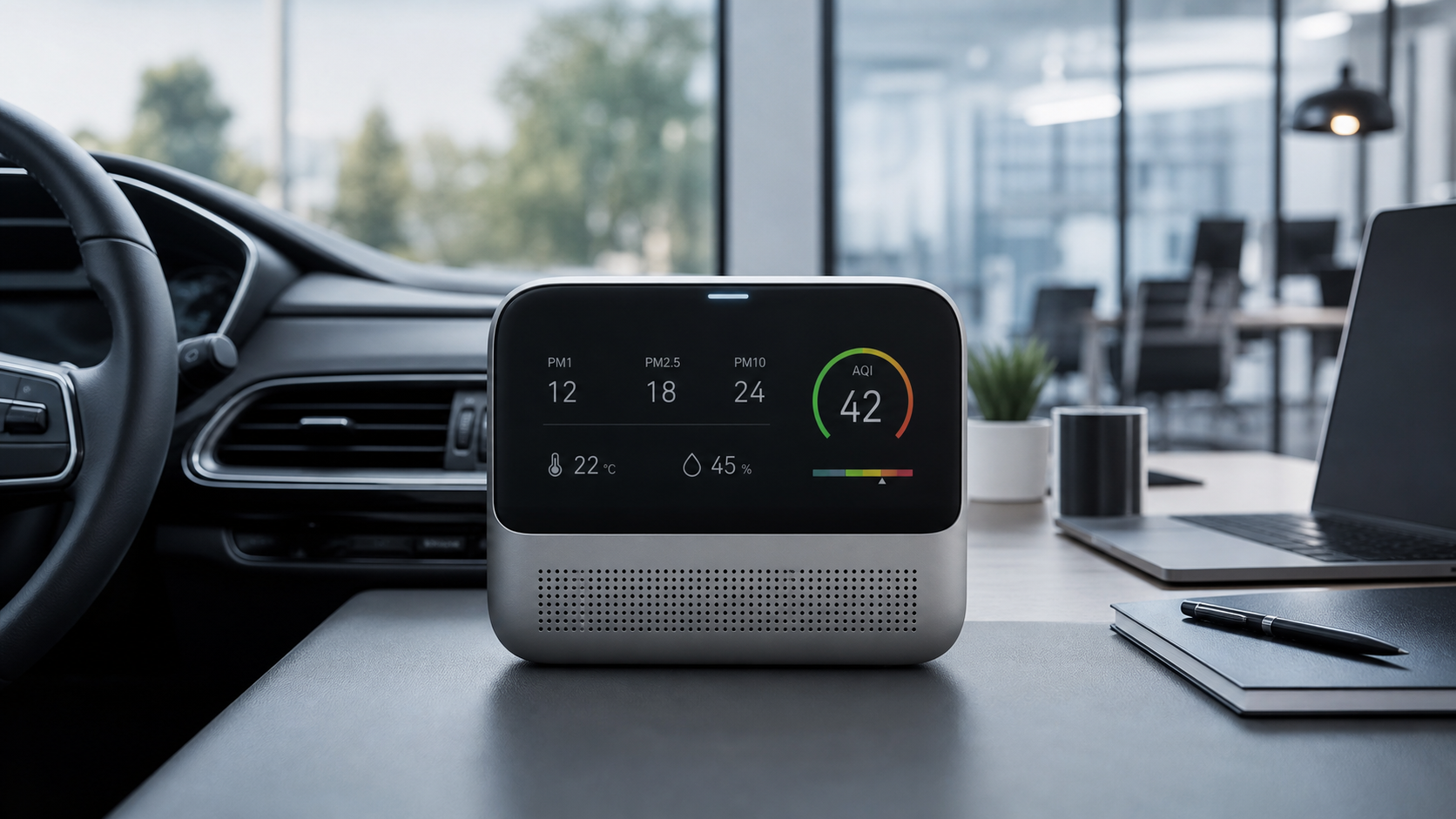
The source article highlights a digital car air quality monitor built around a simple idea: put several environmental readings on one color screen so people can understand air conditions in a home, office, or vehicle at a glance. The device is described as measuring PM1, PM2.5, PM10, temperature, and humidity, with an AQI-style presentation that makes the readings easier to interpret in real time.
That combination matters because air quality is not a single-number problem. Particles, temperature, and humidity change with occupancy, ventilation, weather, commuting patterns, HVAC behavior, and even how long a vehicle sits closed up. A monitor that surfaces those values together gives teams a practical way to see when a space is drifting out of its normal range.
For businesses, the engineering problem is not just sensing. It is deciding what to do with the data after it is captured. Without alerts, thresholds, history, and a workflow for escalation, a monitor becomes a passive display instead of an operational tool. That is where connected device design, software integration, and dashboards become important.
This is the same logic Paw Partners applies in electronic prototyping and IoT system design: sensor data only creates value when it is reliable, visible, and actionable. A well-implemented monitor can support healthier shared spaces, better fleet or facility oversight, and quicker response when conditions change.
What the monitor is really measuring
PM1, PM2.5, and PM10 represent particle size bands, which helps distinguish fine combustion-related particles from larger dust and debris. In practical terms, that means one device can show whether the air problem is likely tied to vehicle exhaust, dust, ventilation gaps, or another source of airborne particulates.
Temperature and humidity are not just comfort metrics. They influence how a space feels, how ventilation behaves, and how quickly particles or moisture-related issues can accumulate. When those readings sit next to particle data on the same screen, users get a more complete operational picture.
The color screen also matters. A clear visual indicator reduces the friction of interpretation for non-technical users, which is useful in offices, shared vehicles, and service environments where the person looking at the display may not be the same person responsible for maintenance or response.
It is still important to treat the monitor as a decision aid, not a full air-quality system. A single device can reveal trends and trigger action, but it does not replace proper engineering review, placement strategy, or a broader sensing plan when the environment is complex.
Where alerts and dashboards add value
In a home office or shared workplace, the biggest advantage of live sensing is speed. If readings rise during occupancy or after a ventilation change, an alert can prompt someone to open a window, adjust HVAC settings, or move people out of the space before discomfort becomes a larger issue.
In a car, the use case is different but related. Vehicle cabins can change quickly as windows open and close, heating or cooling cycles shift, and passengers enter or leave. A compact monitor gives drivers and fleet teams a way to understand those swings instead of guessing based on comfort alone.
For organizations, the most useful next step is connectivity. A monitor that can feed a platform workflow, log conditions over time, or trigger notifications creates a record that operations teams can actually use. That supports threshold-based alerts, trend analysis, and comparison across rooms, routes, or sites.
This is where software architecture matters as much as sensor selection. Dashboards should show the current state clearly, while automated rules handle the repetitive work of notifying the right person. In well-designed systems, that can reduce manual checking and improve response consistency.
What product teams should learn from this category
Air-quality monitors seem straightforward until teams have to build one. Then the hard problems appear: sensor placement, calibration strategy, battery life, display readability, firmware stability, and how to keep readings consistent enough for users to trust them.
Those constraints are exactly why electronic prototyping is valuable. Early hardware iterations can test whether the enclosure distorts airflow, whether the color screen remains readable in daylight or in a car interior, and whether the device is usable when placed in a cup holder, on a desk, or in a shared office.
Connected-device projects also need reliable integrations. If the monitor is part of a larger system, the data should flow cleanly into a cloud service, a facility dashboard, or a maintenance workflow without forcing users to manually transcribe readings. That lowers friction and makes the device more operationally useful.
The source article is a reminder that even a consumer-facing air-quality monitor can expose a broader business requirement: teams want clearer environmental data and faster action. For Paw Partners, that is the core opportunity across sensing, embedded systems, platform workflows, and automation.