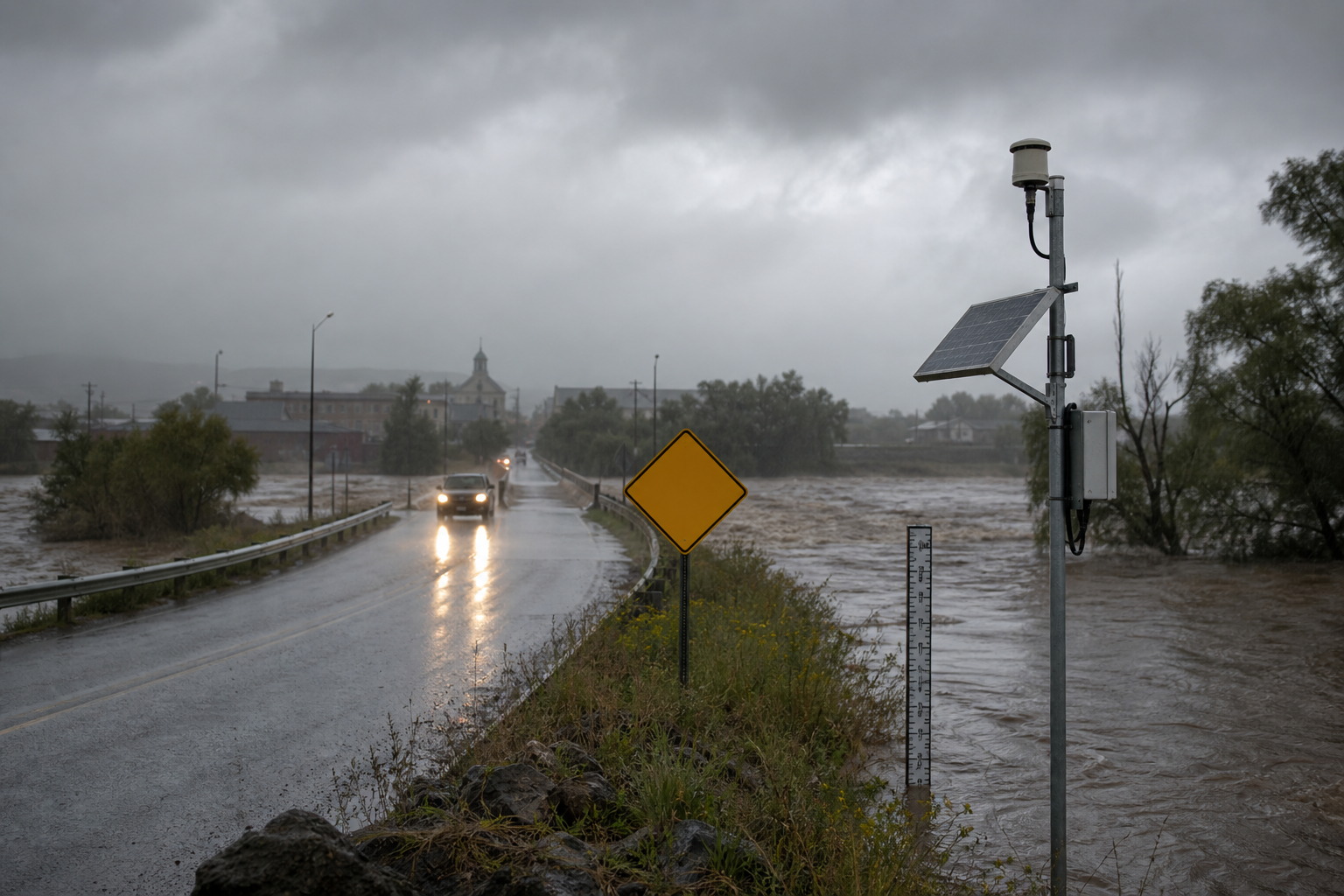
Harris County is moving forward with a countywide roadway flood warning system designed to detect flooding and alert drivers before they enter dangerous water. ABC13 reported on Saturday, February 7, 2026, that the county received a $2 million SMART grant to advance the project. The work is part of a practical public-safety problem that many cities and counties face: road flooding can happen quickly, and once a vehicle reaches deep water, the margin for error drops to almost nothing.
The county’s goal is not just to measure water. It is to turn roadway conditions into operational data that can be used by drivers, public agencies, and emergency responders. That makes this more than a transportation story. It is an engineering, data integration, and alerting story about how to build a reliable warning chain from a sensor in the field to a decision on the road.
Harris County Chief of Infrastructure & Disaster Recovery Samuel Peña said the sensors are intended to provide real-time roadway data in a way similar to the county’s existing flood monitoring for rivers and bayous, but with a specific focus on roads. The first phase is expected to use a public-facing dashboard, followed by a system that can push real-time alerts. That sequencing matters because it shows the county is treating the project as an operational system, not a one-time installation.
The study behind the rollout identified about 117 high-risk areas, roughly 60 miles of county roads prone to flooding, and another 290 or so locations across about 60 more road miles that are considered medium risk. The first phase is expected to take about 18 months. For engineers and operations teams, that scope shows the challenge clearly: flood warning systems are as much about prioritization, coverage, and maintainability as they are about raw sensing.
Why roadway flooding needs a different data model
Road flooding is not the same as monitoring rivers, bayous, or drainage channels. Road risk is localized, often changing by block, intersection, underpass, or low-lying segment. A system designed for road safety must therefore focus on the points where drivers actually make decisions, not only on broad watershed conditions. That is why a roadway warning platform needs location-specific data and clear mapping logic that can be understood quickly during a storm.
The ABC13 report also notes that it is still unclear whether the sensors will detect flooding on each individual road. That uncertainty is important because it reflects a common implementation issue in civic IoT projects: the hardware may be capable of measurement, but the useful outcome depends on where the sensor is placed, how it is calibrated, and whether the thresholds align with real driving conditions. A useful system must reduce ambiguity, not add to it.
What the first deployment has to get right
The county’s proposed public dashboard is a sensible first step because it gives residents and dispatchers a shared operational view. In practice, that dashboard needs more than a map. It needs trustworthy timestamps, clear road status labels, and a simple path from raw measurements to an action a driver can take. If the information is hard to interpret, the warning loses value even if the sensor data is accurate.
The second phase, real-time alerts, raises the bar further. Alerting systems must be resilient, integrated, and conservative enough to avoid false confidence. They also need dependable communications, fallback behavior, and a maintenance plan for failed sensors, power interruptions, or network outages. In environments like Harris County, reliability is not a feature add-on; it is the core product requirement.
What this means for connected infrastructure
This project is a strong example of how connected monitoring can improve response workflows when it is tied to a real operational need. A flood warning network works best when sensing, visualization, and notification are built as one system. That means designing the data pipeline, the dashboard experience, and the escalation logic together instead of treating each layer as separate work.
For organizations building similar systems, the lesson is straightforward: the value is created in the workflow between the sensor and the end user. Paw Partners works in exactly that space through electronic prototyping, connected-device architecture, software systems, dashboards, automation, and integration. Projects like this require disciplined field hardware, dependable data handling, and interfaces that help people act fast when conditions change.
As Peña noted, the National Weather Service data shows that more than 60% of flooding fatalities happen in vehicles, often because people drive into flooded conditions. That makes road-warning systems especially important for prevention. A well-designed platform can help shift the response from reactive rescue to proactive avoidance, which is the highest-value outcome for any safety monitoring program.
Source: ABC13 Houston, published February 7, 2026.