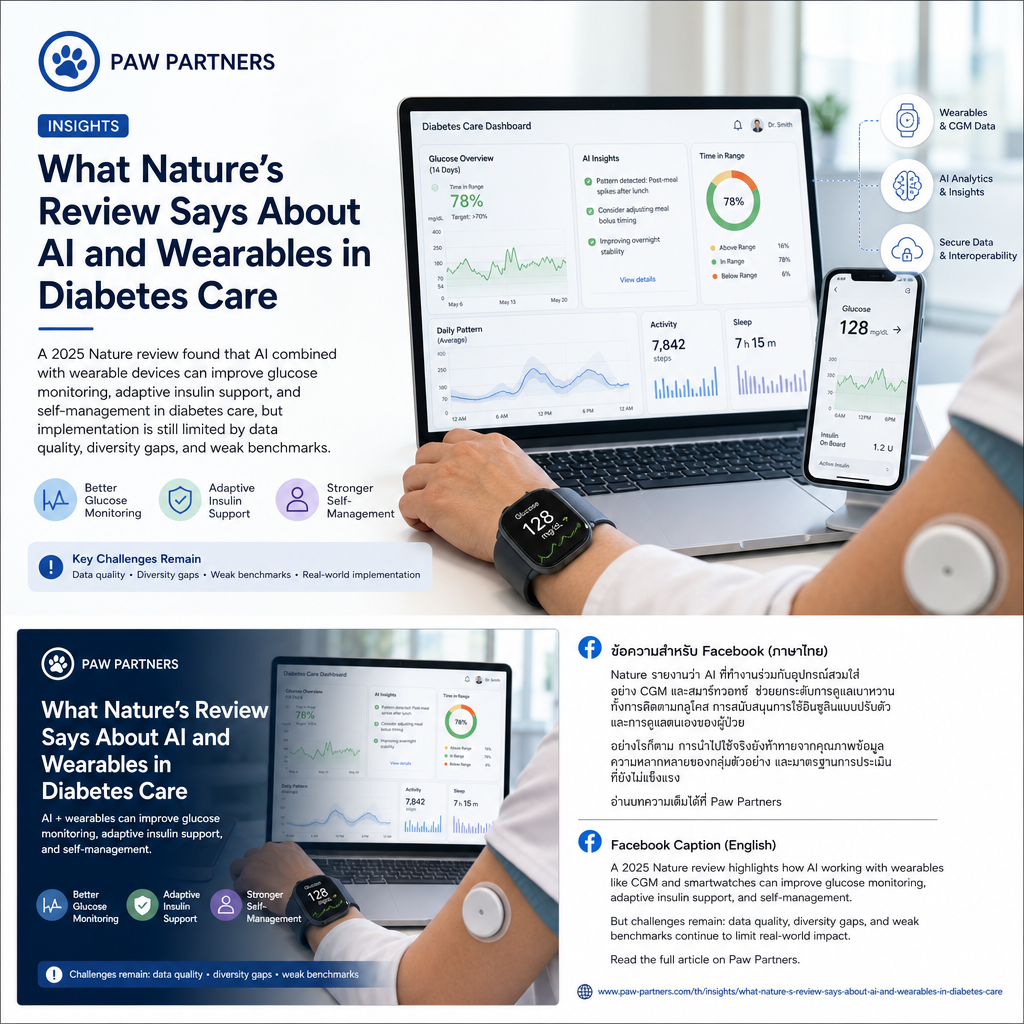
Nature’s npj Digital Medicine published a systematic review on 18 November 2025 examining how artificial intelligence and wearable technology are being combined in diabetes and prediabetes care. The review looked at more than 5,000 records and included 60 studies, so it reflects a broad snapshot of where the field is today rather than a single product claim or a narrow pilot.
The central finding is practical: AI can add value when it is paired with continuous, real-world device data. In the reviewed studies, AI models connected to wearables showed promise for glycemic monitoring, adaptive insulin management, and predicting diabetes-related events. Continuous glucose monitors were especially common, but the broader pattern was clear across smartwatches, fitness trackers, and other sensors.
That matters because the business problem is not model design alone. Healthcare teams need dependable device capture, clean data pipelines, and workflows that turn raw sensor streams into decisions clinicians and patients can trust. Without those layers, even strong algorithms stay stuck in research settings.
For connected health companies, including teams building medical devices, patient apps, and platform dashboards, this review is a reminder that the real value comes from the full system: hardware, software, automation, integration, and operational reliability working together.
What the review actually found
The review included 60 studies after screening more than 5,000 records. Most of the evidence focused on type 2 diabetes, where AI was used with wearable-derived physiology data to improve monitoring, support self-management, and explore more adaptive treatment approaches.
Continuous glucose monitors appeared in the majority of studies, which is not surprising. CGMs produce continuous, high-resolution glucose data that are well suited to machine learning, event prediction, and decision support. The review also noted smartwatches, fitness trackers, and other sensors that expanded the data mix beyond glucose alone.
There was also a clear trend toward more varied applications over time. Early work was concentrated on glucose prediction, while later studies expanded into insulin management, activity classification, stress estimation, and other clinical or behavioral signals. That progression suggests the category is maturing from narrow forecasting toward multimodal care support.
Why the data layer is the real constraint
The strongest message for engineering teams is that data quality determines whether AI is useful or fragile. The review flagged limited demographic diversity, small sample sizes in many studies, and inconsistent reporting of race and ethnicity, which all reduce generalizability and can distort model performance across patient groups.
It also highlighted variable data quality and a lack of standard benchmarks for judging model performance. In practice, that means two systems may look promising in separate studies yet behave differently once they meet real patients, noisy sensors, missing samples, and uneven engagement.
For Paw Partners-type programs, this is where architecture matters. Wearable data must be normalized, timestamped, validated, and routed through dependable workflows before it becomes a clinical or operational signal. AI can only be as trustworthy as the device ingestion, synchronization, and quality-control layers underneath it.
What implementation teams should build next
The review’s limitations point directly to product and platform priorities. Teams need transparent models, clearer evaluation criteria, and human-readable outputs that explain why a prediction was made, not just what the prediction was. That is especially important when results influence insulin decisions or behavior change coaching.
Operationally, this means designing systems that support monitoring, alerting, audit trails, and exception handling across the full device-to-dashboard path. If wearables drop data, if a sensor drifts, or if a patient’s usage pattern changes, the platform should surface that condition instead of silently passing it downstream.
For organizations working in connected devices and digital health, the opportunity is not simply to add AI to an app. The opportunity is to build a reliable operating layer that unifies sensor data, care workflows, and analytics so clinicians and care teams can act on signal instead of noise.