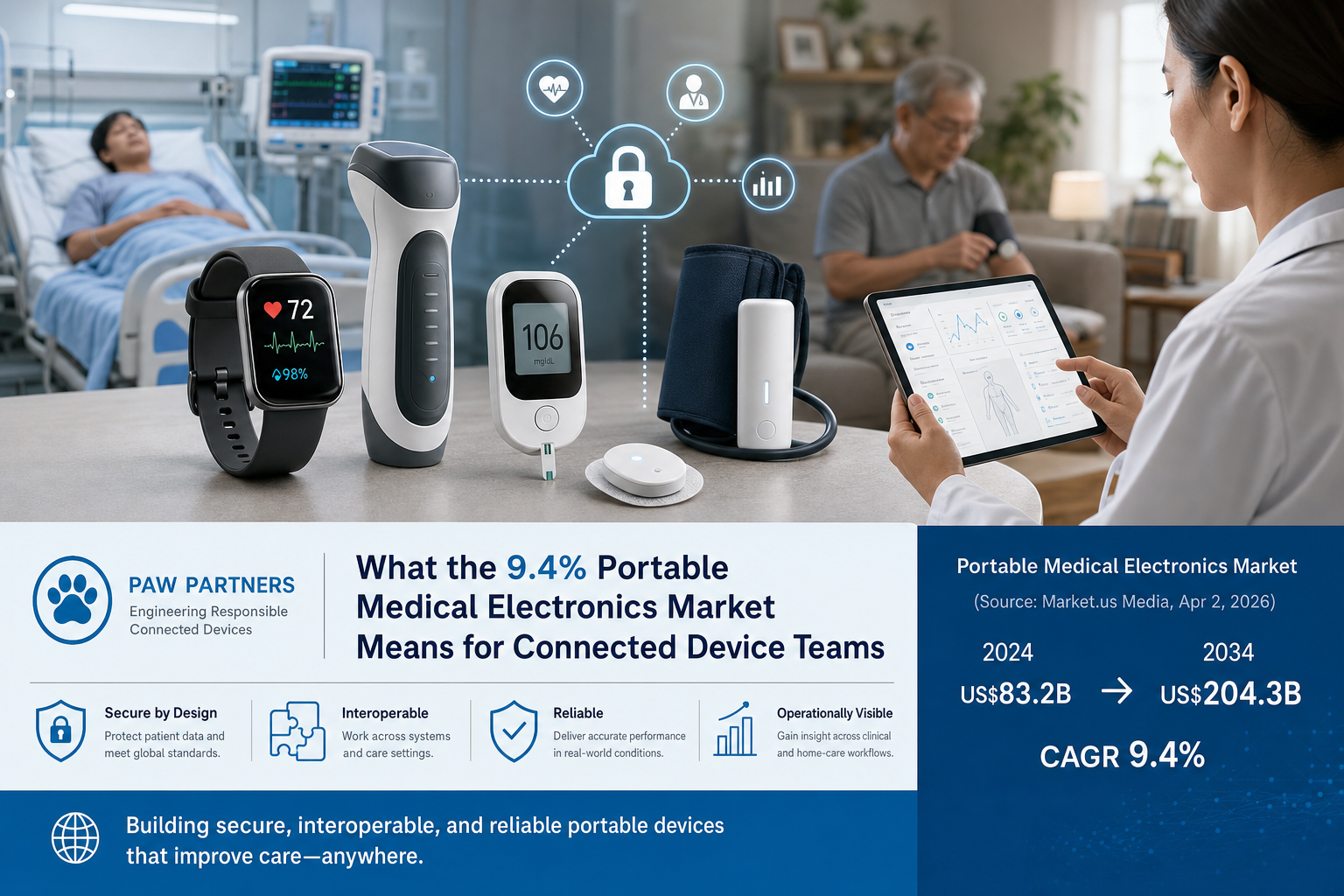
On April 2, 2026, Market.us Media reported that the portable medical electronic products market is expected to rise from US$83.2 billion in 2024 to US$204.3 billion by 2034, representing a 9.4% CAGR over the forecast period. The same report noted that North America held a 41.1% market share in 2024, which underscores how strongly connected care and mobile diagnostics are already embedded in the region.
The category is broad, but the common thread is clear: these are compact, battery-powered devices used to monitor, diagnose, or support care outside a fixed clinical setting. The report includes wearable vital-sign monitors, handheld diagnostics, portable imaging systems, pulse oximeters, ECG monitors, infusion pumps, and connected glucose meters. These devices are used across hospitals, home care, ambulatory settings, emergency services, and rural care programs.
That matters because growth in this market is being driven by more than device demand. It reflects a shift toward home healthcare, chronic disease management, and remote patient monitoring, where the value of the product depends on the quality of the data path around it. A portable device that cannot reliably transmit readings, authenticate users, or fit into a clinician’s workflow becomes a partial solution instead of an operational one.
For engineering teams, this market is not just about miniaturizing hardware. It is about delivering a complete system that can hold up in the field: stable power, secure wireless communication, cloud synchronization, regulatory traceability, and interfaces that clinicians and patients can use without friction. That is exactly where integration discipline becomes a business differentiator.
What the market data says about product strategy
The report’s segment data suggests that buyers are rewarding devices that solve high-frequency clinical problems. Diagnostic imaging led the product mix with a 48.6% share in 2024, while cardiology represented 32.8% of application share. Hospitals remained the largest end-user group at 54.2%, which indicates that portable devices still need to work inside formal care settings, not only in consumer-like home environments.
That combination is important for product strategy. A device aimed at cardiology or point-of-care imaging must do more than produce an accurate measurement. It must support rapid setup, dependable workflow handoff, and clear data presentation for the next user in the chain, whether that is a nurse, physician, technician, or remote monitoring team.
The regional picture reinforces the same point. North America is already a large and mature market, while Asia Pacific is expected to grow fastest as healthcare infrastructure and telemedicine adoption expand. In both cases, the winning product is likely to be the one that can scale without creating support burden, data silos, or inconsistent user experiences.
The engineering problems behind portable care
Portable medical electronics are constrained by competing requirements. They must be small, durable, lightweight, and power-efficient, yet also precise, secure, and simple to use. In practice, that means teams have to balance industrial design, sensor performance, battery life, wireless connectivity, and clinical usability in one architecture.
Reliability becomes even more important when devices move between hospital floors, ambulances, clinics, and homes. The engineering standard is not just whether the device works in the lab; it is whether it continues to perform under changing environments, intermittent connectivity, transport stress, and real-world handling by non-specialist users.
Data security and interoperability are equally central. The report explicitly points to wireless connectivity, real-time transmission, and cloud platform integration, which means every device is also a software and systems problem. If data cannot flow safely into EHR-connected workflows, telehealth systems, or internal dashboards, the device creates more manual work than value.
That is why traceability, test automation, and release discipline matter. Portable devices often move quickly from prototype to pilot, and then into regulated production environments. Without a structured engineering process, teams risk late-stage rework in hardware, firmware, mobile apps, and backend services at the same time.
How Paw Partners can help teams build for scale
For companies working in portable medical electronics, Paw Partners can support the path from concept to connected product with electronic prototyping, embedded development, and integration planning. That includes shaping the device, the companion software, and the data model together instead of treating them as separate deliverables.
Operationally, the bigger advantage is visibility. Dashboards, workflow automation, and system integration can help teams monitor device status, patient data flow, exception handling, and service events across the product lifecycle. That reduces blind spots when pilots expand into larger deployments.
For teams launching remote monitoring or connected diagnostic products, the practical goal is simple: make the device dependable in the field and make the system understandable to the people running it. The market is growing, but the winners will be the companies that turn portable hardware into a reliable operational platform.
Source: Google News RSS article and Market.us Media report.