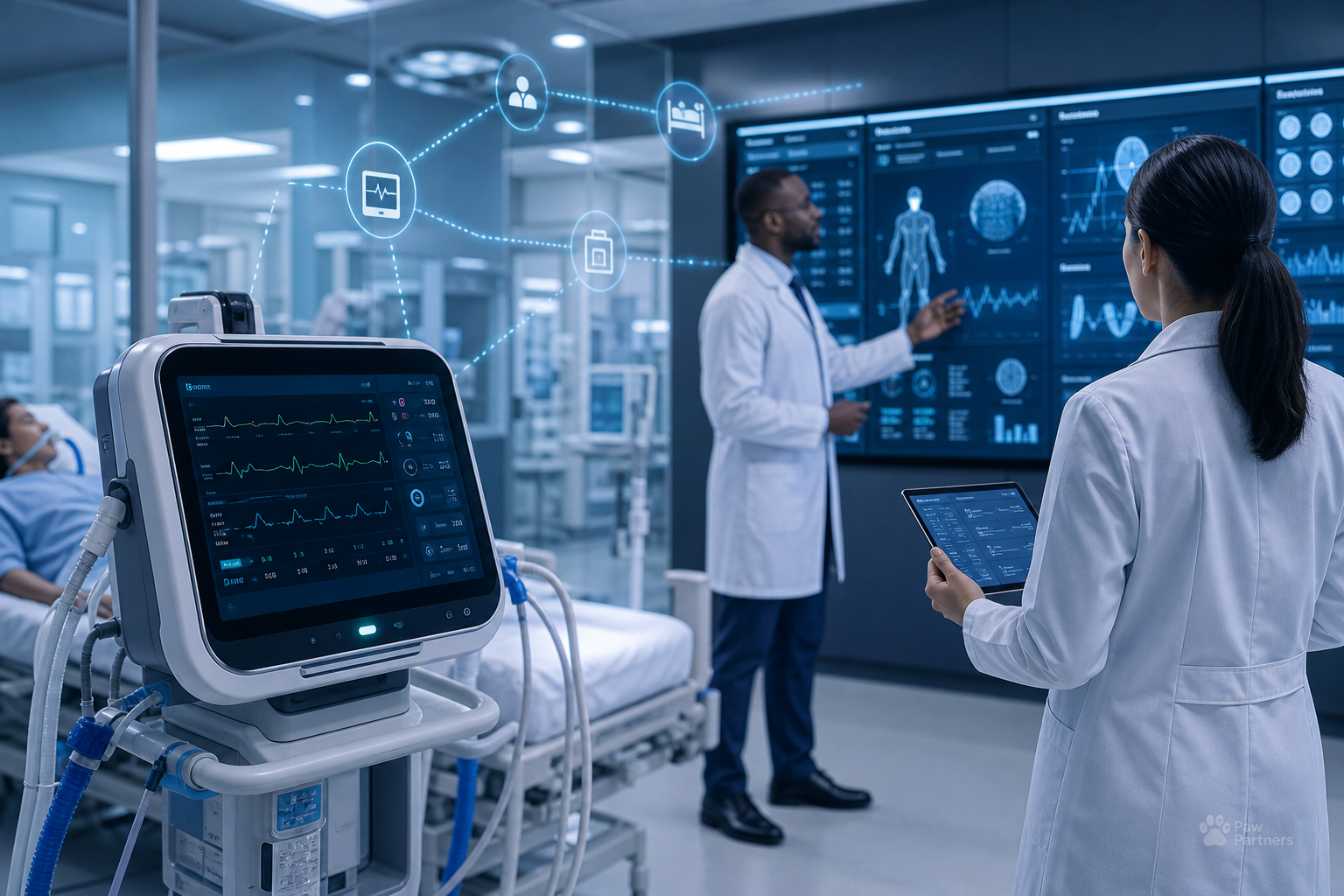
Fortune Business Insights published an April 2026 outlook on the AI-enabled medical devices market, projecting growth from USD 9.11 billion in 2025 to USD 45.87 billion by 2034. The report frames this as a sustained shift in how regulated medical products are being designed, deployed, and used across care settings.
The market is not only about smarter algorithms inside devices. It is about embedding AI into screening, image analysis, diagnosis, monitoring, workflow prioritization, and treatment support. That distinction matters because the commercial value increasingly depends on the quality of the software layer, the reliability of the data pipeline, and the ability to turn raw device output into decisions that clinicians can trust.
For healthcare providers and medtech teams, the business problem is larger than model accuracy. Hospitals need secure device connectivity, usable dashboards, predictable integration with clinical systems, and operational visibility across departments. Without those foundations, AI features can become isolated capabilities instead of practical workflow tools.
The report also shows where demand is concentrating. North America held 41.6% of the market in 2025, and the U.S. remained the leading country in the region. At the same time, the report points to strong use cases in imaging-led specialties, remote monitoring, and connected health, which suggests that the winning products will be the ones that combine reliable hardware with software that performs in real operational environments.
What the forecast says
The headline numbers indicate a market moving from early adoption into scaled deployment. Fortune Business Insights estimates a 19.85% CAGR from 2026 to 2034, which is consistent with rising clinical use of AI-enabled tools and expanding authorization for clinical applications.
The report notes that the global market is being driven by faster and more accurate diagnostic needs, a growing number of medical imaging procedures, and the increasing use of predictive AI in hospitals. In practical terms, that means device makers are being asked to deliver tools that save time without adding friction to already busy care pathways.
The report also identifies the hardware and devices segment as the expected leader by component. That is an important signal for product teams: the market still depends on the physical device, but the differentiator is increasingly the software experience around it, including automation, connectivity, and data interpretation.
Where the demand is coming from
Wearables and remote monitoring are highlighted as a significant trend, and that aligns with the broader move toward care that extends beyond the hospital. AI-enabled devices can help clinicians detect changes earlier, triage patients more effectively, and reduce the amount of manual review needed for routine monitoring.
The report also points to strong hospital demand, where AI tools support radiology, surgery, and patient monitoring. Hospital settings accounted for the largest revenue contribution in the report’s view, reflecting both complex case mix and a high need for workflow efficiency.
Homecare settings are projected to grow faster than many mature segments, which is a reminder that device design now has to account for non-clinical environments. That raises engineering requirements around connectivity reliability, battery performance, data sync behavior, alert quality, and user experience for patients and caregivers.
For companies building connected medical products, this is where systems thinking matters. A device that works in the lab but struggles with fleet management, data transfer, or dashboard consistency will not support the operational model that healthcare customers expect.
Regional and product implications
North America led the market in 2025, supported by advanced healthcare infrastructure, high adoption of digital health technologies, and a strong concentration of medical device and technology companies. Europe is growing on the back of aging populations and chronic disease burden, while Asia Pacific is expanding through healthcare infrastructure investment and rising demand for imaging, cardiology, ophthalmology, and screening tools.
That mix suggests a market that is both globally large and locally complex. A successful product strategy will need to account for different care models, different integration requirements, and different deployment conditions across regions.
The competitive landscape is moderately fragmented, with companies such as Medtronic, Siemens Healthineers, Koninklijke Philips, GE HealthCare, and others focusing on AI-integrated product innovation. The report also notes a rising emphasis on software-linked recurring value, strategic collaborations, and expansion across multiple care settings.
For Paw Partners, the engineering lesson is clear. AI-enabled devices only create durable value when they are supported by dependable electronics prototyping, secure connected-device architecture, software systems that move data cleanly, and operational dashboards that make device fleets and clinical workflows observable in real time.
That same approach also helps reduce integration risk. When device data can move reliably into hospital platforms, automation layers, and service workflows, AI features become easier to operationalize and easier to scale across product lines.
Source: Fortune Business Insights, AI-enabled Medical Devices Market
What it means for engineering teams
The market forecast is not just a demand signal for medtech sales teams. It is a requirement map for engineering organizations that need to build products with clinical reliability, traceable data handling, and lifecycle support from prototype to deployment.
Teams that treat AI as a device feature rather than a system capability risk underbuilding the surrounding infrastructure. The report points to the value of workflow prioritization and monitoring, which means dashboards, alerts, integration points, and operational visibility are part of the product, not optional extras.
In that context, Paw Partners can support the move from concept to field-ready system by aligning hardware, firmware, cloud services, and workflow automation around the realities of healthcare operations. That is where connected sensing and dependable software deliver measurable value.
For buyers, the takeaway is equally practical: the next generation of medical devices will be judged not only on what they can detect, but on how reliably they fit into the clinical and operational systems around them.