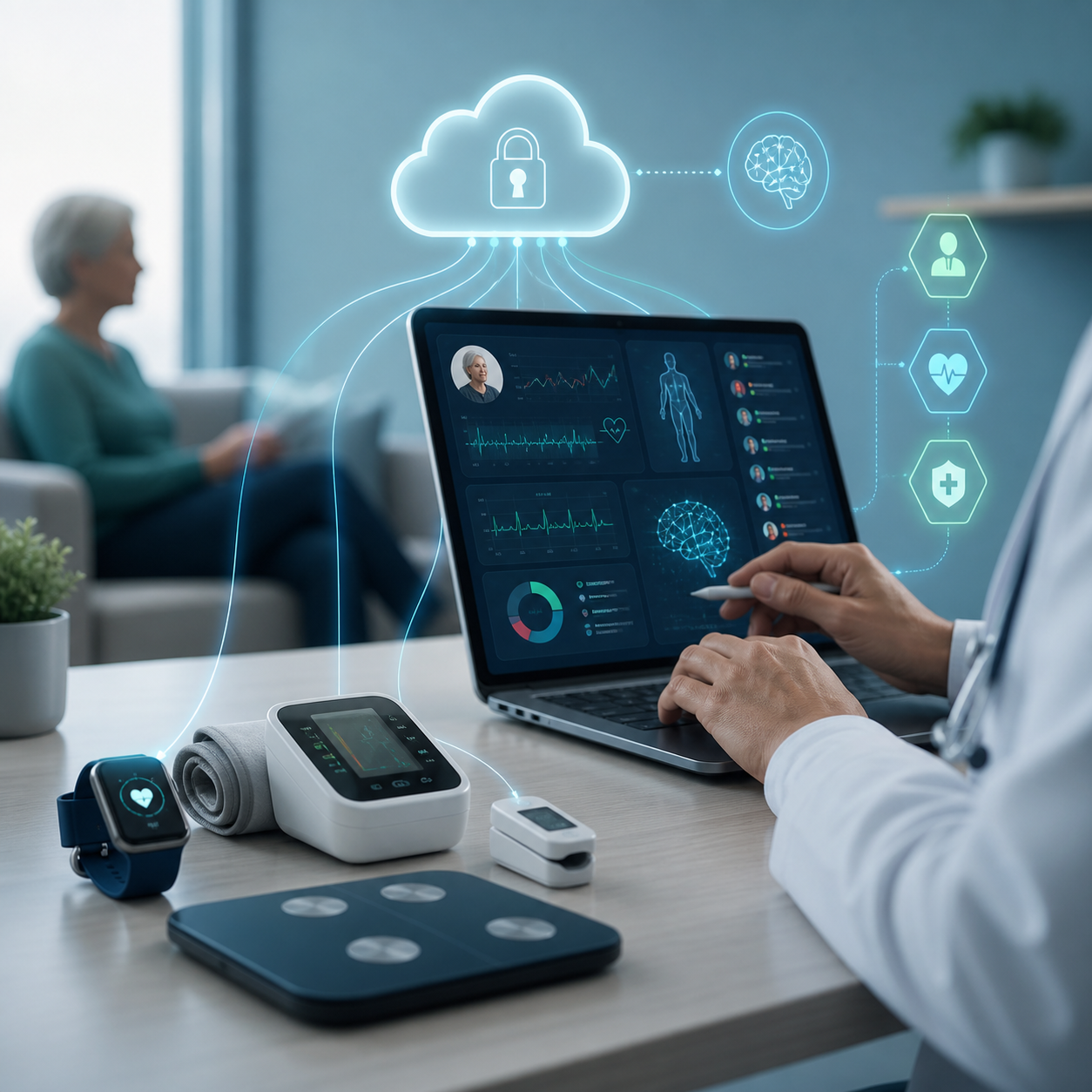
Fortune Business Insights’ article on the AI in remote patient monitoring market signals a familiar pattern in digital health: the market is moving from simple data collection toward decision support. Remote patient monitoring has already established the value of connected sensors, wearables, and patient-generated data. The next step is using artificial intelligence to help care teams prioritize what matters, identify exceptions faster, and reduce the manual work that comes with continuous monitoring.
The source is especially relevant because it frames AI as part of a broader market outlook rather than a narrow feature discussion. That matters for healthcare vendors, device makers, and software teams because the business problem is no longer just whether data can be captured. The harder question is whether data can be trusted, routed, interpreted, and acted on in time. In practice, this shifts the technical focus toward reliability, integration, and workflow design.
For healthcare organizations, the opportunity is operational as much as clinical. Continuous monitoring can generate large volumes of readings, alerts, and exception cases. Without the right system architecture, teams can end up with alert fatigue, fragmented patient views, and delayed interventions. AI can help, but only when it is embedded in a platform that supports clean device data, secure transport, and clear escalation logic.
For companies building in this space, the article is a reminder that remote patient monitoring is becoming a platform challenge. The winning products will not be defined only by sensing hardware or model accuracy. They will be defined by how well they connect devices, software, dashboards, and care workflows into a dependable operational loop.
Why AI Matters in Remote Patient Monitoring
Remote patient monitoring works best when it turns scattered measurements into a usable picture of patient status. AI adds value by helping systems detect trends, filter noise, and flag anomalies that may need review. That is important in environments where staff cannot manually inspect every reading and where response time affects patient outcomes.
The market signal behind the Fortune Business Insights report suggests that buyers are looking for practical efficiency, not just analytics branding. They want fewer missed signals, better prioritization, and less time spent sorting through low-value alerts. That pushes product teams to design AI features that are explainable and operationally useful, rather than opaque scoring layers that clinicians cannot trust.
From an engineering perspective, AI in this setting depends on data quality. Sensor drift, intermittent connectivity, missing timestamps, and inconsistent device behavior can all reduce the usefulness of downstream models. The reliability of the AI output is only as strong as the sensing chain, so device firmware, gateway logic, and backend validation matter as much as the model itself.
The Technical Stack Behind Reliable RPM
Connected care platforms need a stable ingestion layer that can handle multiple device types, variable connectivity, and patient-level identity mapping. In practice, this means integrating medical devices and IoT sensors into a system that normalizes data formats, preserves provenance, and supports secure transmission from edge to cloud.
Secure data flows are not optional in healthcare, especially when monitoring is continuous and distributed. Teams need authentication, encryption, auditability, and access control built into the platform design. If the data path is not trustworthy, then neither AI outputs nor operational dashboards will be trustworthy.
Dashboards are where the business value becomes visible. A well-designed operations view should let clinicians, coordinators, and support staff see patient trends, exceptions, device status, and escalation state without switching between tools. That is where software systems can reduce friction: by turning raw monitoring data into a shared operational surface.
Paw Partners’ strengths in electronic prototyping, IoT-connected devices, platform workflows, and dashboard systems fit this problem closely. In remote patient monitoring, the engineering work often spans hardware validation, cloud integration, alert routing, and user-facing visibility. Those pieces have to work together if the program is going to scale reliably.
What Healthcare Teams Should Build Next
Healthcare product teams should think in terms of closed-loop workflows. It is not enough to detect an out-of-range value. The system also needs to decide who should see it, when they should see it, what context they need, and what happens after the alert is acknowledged. That workflow design often determines whether monitoring reduces risk or simply creates more notifications.
Automation is especially valuable when it removes repetitive administrative work. For example, systems can route stable readings into summary views, escalate exceptions based on configurable thresholds, and generate task queues for follow-up. This is where AI can complement rules-based logic: one layer handles predictable triage, while the other helps identify unusual patterns.
The most durable RPM programs also build for integration. Monitoring data is more useful when it connects to EHR workflows, reporting systems, support tools, and internal operations dashboards. A disconnected pilot may demonstrate the concept, but an integrated platform is what creates repeatable operational value.
For buyers evaluating vendors, the question should be whether the solution is built for real-world reliability. That includes device lifecycle management, backend observability, exception handling, and support for scale across patient populations. In a market moving toward AI-assisted monitoring, the companies that invest in these fundamentals will be better positioned to convert market interest into lasting adoption.