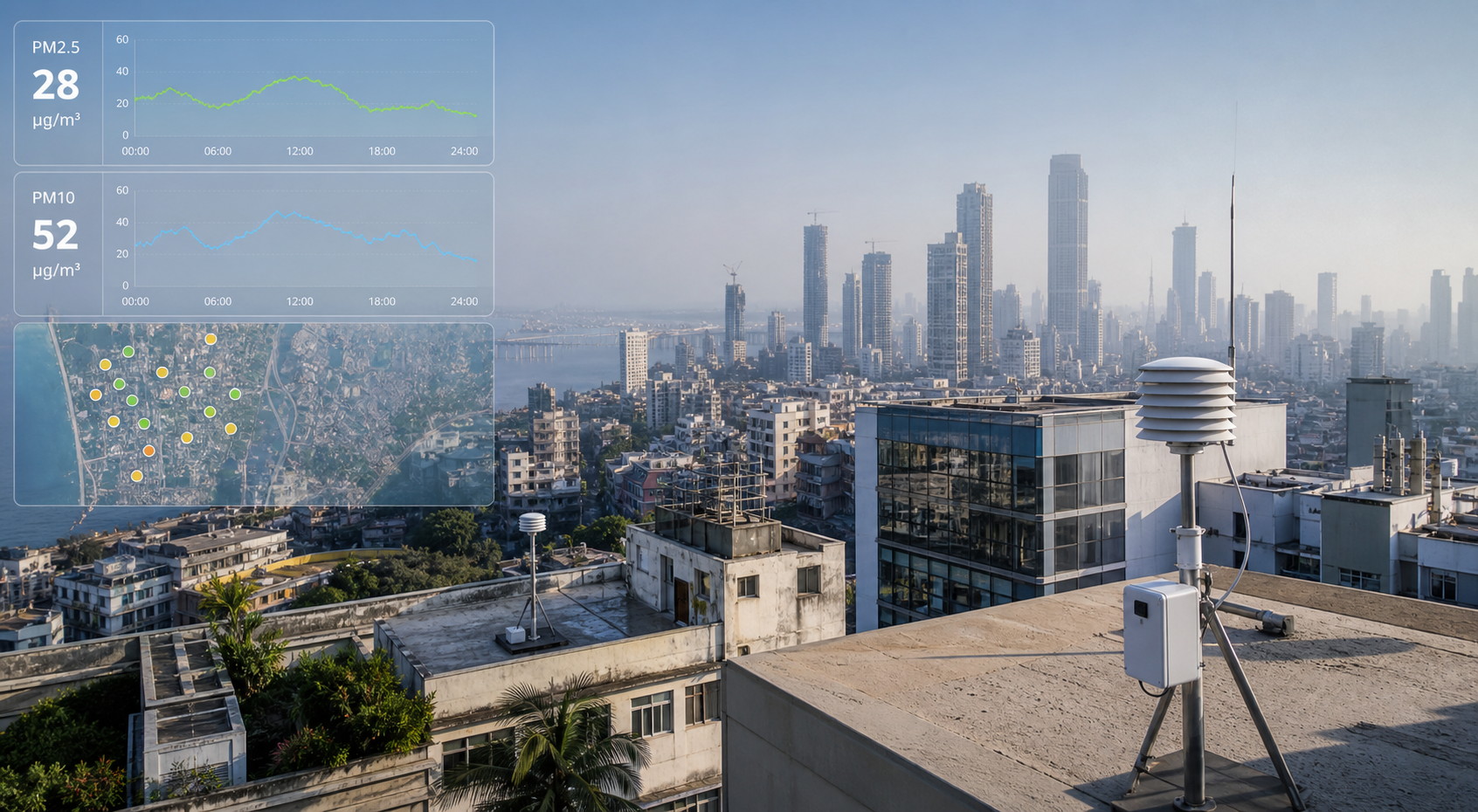
On April 9, 2026, reporting on Mumbai’s air-quality program described how the Brihanmumbai Municipal Corporation, or BMC, is expanding monitoring through hyperlocal sensor testing across the city. The shift is important because it moves the conversation from broad pollution averages to location-specific readings that can support faster action.
The core issue is not just whether air pollution is high, but where it is rising, how quickly conditions change, and whether the measurement system can be trusted at street level. In a dense city like Mumbai, ward-level visibility is often too coarse for day-to-day operational decisions. Hyperlocal sensing is meant to close that gap.
According to the reporting, BMC’s approach includes testing low-cost sensors through co-location studies against existing monitoring stations before wider deployment. The broader plan points toward a network of around 75 sensors, with installation on BMC properties such as ward offices, hospitals, and schools, and a cloud-based dashboard for reading the data.
For city administrators, builders, and infrastructure operators, this is more than an environmental story. It is a practical systems problem: data quality, calibration, alerting, and accountability all need to work together. That is exactly the kind of workflow challenge where connected devices, automated dashboards, and reliable integration matter as much as the sensor hardware itself.
Why hyperlocal monitoring matters
Citywide air-quality averages are useful for public communication, but they rarely tell operators what is happening on a specific block, near a construction zone, or around a school. Hyperlocal sensors are intended to give decision-makers a more precise picture of pollution patterns as they unfold.
That precision matters because the same city can contain very different conditions within a short distance. A neighborhood near heavy traffic, construction activity, or industrial movement may need a different response than a nearby area with lower exposure. Better granularity creates better intervention options.
The reporting also noted that around 10 sensors are being tested near existing Continuous Ambient Air Quality Monitoring Systems, or CAAQMS, to validate performance. That step is important because low-cost devices can drift if temperature, humidity, or placement affects their readings. Without calibration, more data does not automatically mean better data.
What the rollout reveals about system design
Any sensor network is only as useful as the pipeline behind it. Raw readings need to move into software systems that clean, compare, visualize, and distribute the information in a form people can act on quickly.
That is where dashboards and alert rules become central. A live map or dashboard can show hotspots as they emerge, while automation can flag threshold breaches, route notifications, or trigger field inspection workflows. For a civic operator, that reduces the lag between detection and response.
The report indicates that the city is planning to divide Mumbai into grids of roughly eight square kilometers, with one sensor per grid. That kind of design shows an attempt to balance coverage, cost, and operational manageability, which is a common engineering tradeoff in connected-device deployments.
What businesses can take from this
Organizations facing air-quality, safety, or compliance pressure can learn from the same pattern. The challenge is not limited to municipalities; factories, logistics hubs, campuses, and construction programs all need reliable sensing, contextual alerts, and auditable records.
For Paw Partners, the relevant lesson is how electronic prototyping and IoT platform design support real-world reliability. A useful system needs the right sensor enclosure, power profile, connectivity strategy, calibration workflow, and backend integration so teams can trust the data when it matters.
It also needs operational discipline. When alerts are tied to clear escalation paths, field teams know what to check, managers know when to intervene, and leadership can compare trends over time instead of reacting to isolated readings. That is how sensor data becomes a decision tool instead of just a dashboard metric.
In that sense, Mumbai’s hyperlocal monitoring effort is a strong example of the wider shift toward instrumented operations. The value comes not only from measuring more things, but from building a dependable system that turns measurements into action.
Source: Prop News Time via Google News.