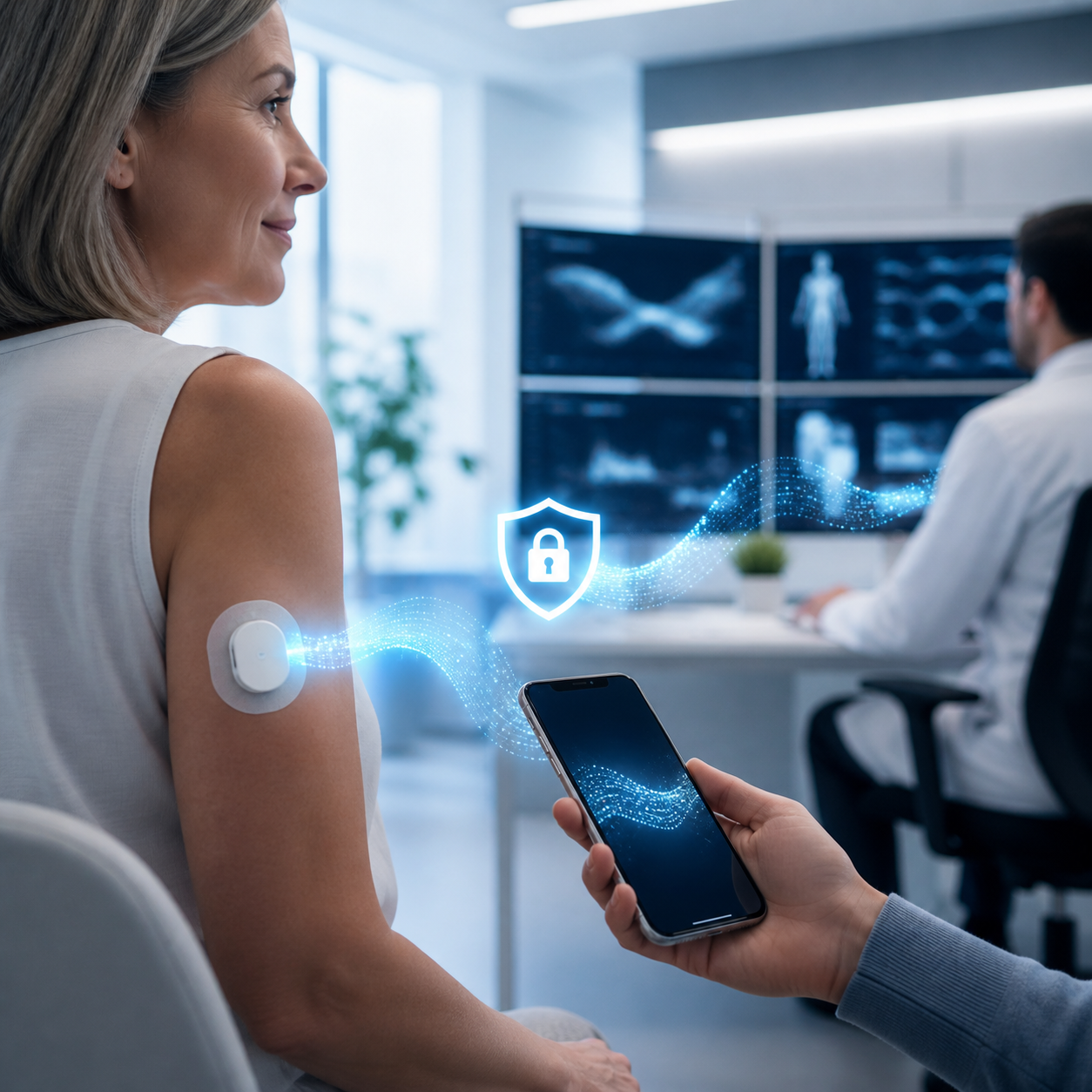
On March 31, 2026, Barchart syndicated DelveInsight’s latest wearable medical devices market analysis, projecting growth from USD 42,981.29 million in 2024 to USD 185,415.73 million by 2032. The report puts the market on a 20.07% CAGR for the 2025 to 2032 period, which is a strong signal that wearables are moving from a consumer accessory category into a serious part of healthcare delivery.
The core drivers are familiar but important: AI integration, remote patient monitoring, and the rising burden of chronic disease. DelveInsight also points to the role of an aging population, broader adoption of connected health workflows, and growing demand for real-time tracking of vital signs such as heart rate, blood pressure, glucose, oxygen saturation, and ECG data.
For healthcare organizations and device teams, the market number matters less than the operating model behind it. As wearables become more clinical, the hard problem shifts to data quality, secure transport, alerting logic, device interoperability, and the ability to turn continuous streams of patient data into decisions that clinicians can trust.
That is where the engineering challenge becomes real. Each additional sensor, app, gateway, and platform connection introduces a new reliability risk. For Paw Partners, this is exactly the kind of system problem that spans electronic prototyping, IoT connectivity, software integration, workflow design, dashboards, and automation.
What the Market Growth Actually Means
DelveInsight’s analysis shows that the wearable medical devices category is no longer limited to fitness tracking. It now includes clinically relevant tools that support monitoring, diagnosis, and in some cases therapy. The strongest demand is coming from chronic disease management, where continuous visibility is more useful than occasional point-in-time checks.
The report also identifies diagnostic and monitoring devices as the largest segment, with smartwatches accounting for nearly 45% of global revenue. That matters because it shows how quickly consumer hardware has started to absorb medical-grade features, including ECG monitoring and irregular rhythm detection.
For product teams, that convergence creates a design requirement: the system must handle both consumer expectations and clinical expectations at the same time. A device that feels simple to the user still needs robust telemetry, predictable uptime, and a backend that can support care workflows without introducing noise or delay.
Where the Technical Friction Lives
The report is equally clear about the constraints. Data privacy and security remain a major concern, especially when sensitive health information is moving through mobile apps, cloud services, and third-party systems. Technical limitations also persist, including sensor accuracy, battery life, and data reliability.
Interoperability is another pressure point. Wearable programs only work at scale when device data can move cleanly into telehealth platforms, clinician dashboards, and downstream systems with consistent identifiers, timestamps, and exception handling. Without that layer, continuous monitoring becomes disconnected data capture rather than operational care support.
- Secure onboarding: device identity, authentication, and encryption from the start.
- Reliable data flow: resilient transport from device to app to backend services.
- Clear alert logic: thresholds and escalation paths that reduce false positives.
- Interoperable integrations: APIs and data models that fit existing care systems.
- Operational visibility: dashboards that show device health, data gaps, and patient exceptions.
How Teams Should Build for Scale
The report highlights North America as the largest market and Asia-Pacific as the fastest-growing region. It also notes that recent developments include FDA clearances for advanced wearable features, prescription-free continuous glucose monitoring systems, expanded wearable biosensors, and more partnerships between technology and healthcare companies.
That combination suggests the same lesson for every team entering this space: success is not just about the sensor. It is about the full stack around it, from electronic prototyping and connectivity testing to platform workflows that route data to the right person at the right time. Reliable connected care depends on software systems that can normalize mixed device inputs, surface operational exceptions, and support auditability.
For Paw Partners, the practical opportunity is to help teams move from prototype to production with connected-device architectures that are secure, observable, and maintainable. In wearables, the winning product is not the one that merely collects more data; it is the one that turns data into dependable action without adding burden to clinicians or patients.
Source: Barchart syndication of DelveInsight’s wearable medical devices market analysis.